Introduction
If you applied for the CTET September 2026 exam and just realized you misspelled your name, picked the wrong category, or uploaded a blurry photo — don’t panic. The Central Board of Secondary Education (CBSE) gives every candidate a short but important second chance: the CTET September correction window.
This guide walks you through everything you need to know about the CTET September Correction/Edit Form 2026 — when the link goes live, what you can and can’t change, the full exam timeline, eligibility criteria for Paper 1 and Paper 2, and practical tips to get it right the first time (because there won’t be a third chance).
Whether you’re a first-time applicant or someone reapplying after a previous attempt, this article gives you a clear, no-jargon roadmap.
Table of Contents
- CTET September 2026: Quick Overview
- Correction Window Dates – When It Opens and Closes
- What You Can Edit (and What You Can’t)
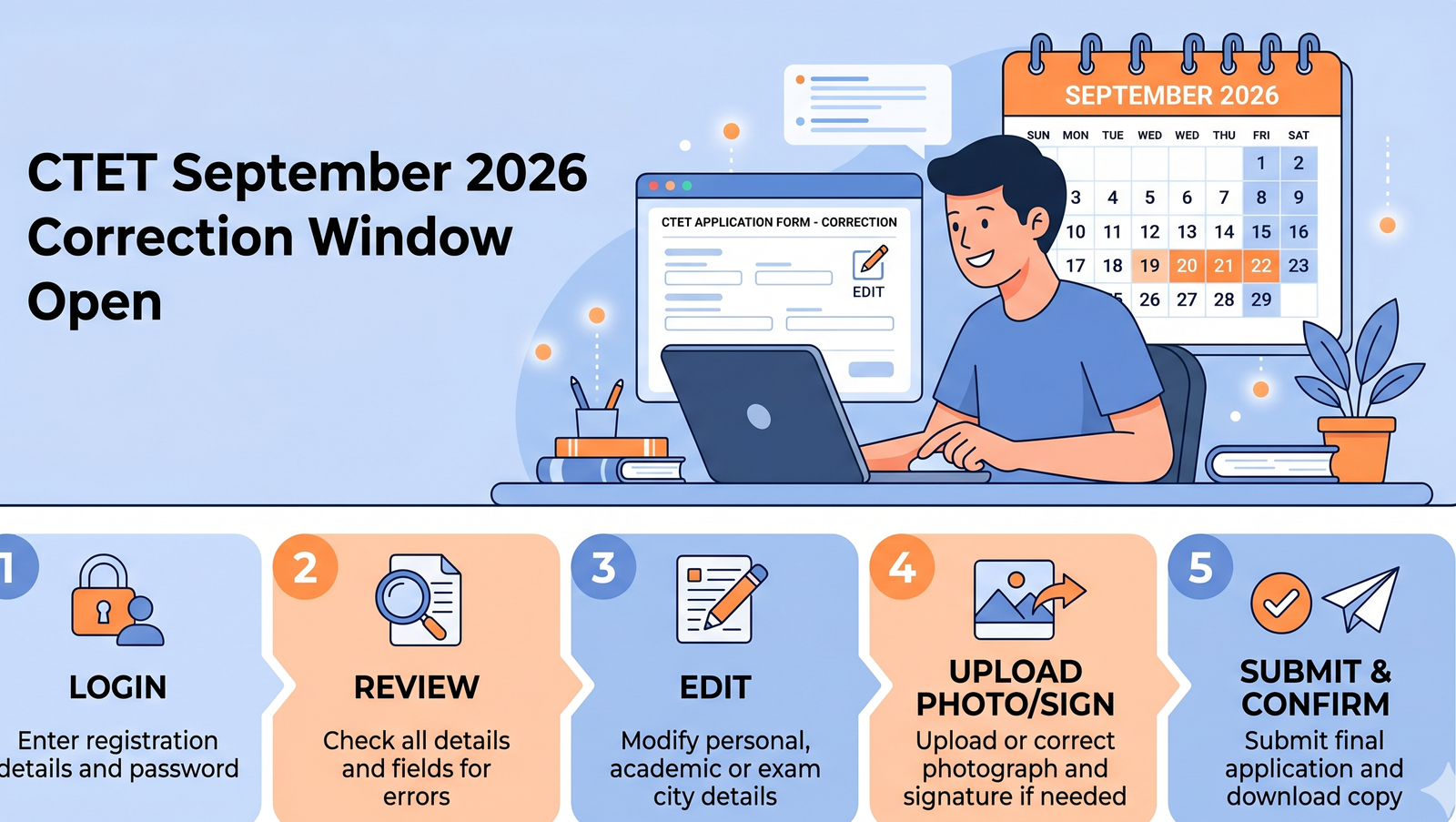
- Step-by-Step Guide to Edit Your CTET Application Form
- CTET Eligibility Criteria 2026 (Paper 1 & Paper 2)
- Why the Correction Window Matters
- Common Mistakes Candidates Make
- Tips & Best Practices Before the Window Closes
- Latest Updates and Trends
- Key Takeaways
- Conclusion
- FAQs
CTET September 2026: Quick Overview
CBSE released the official CTET September 2026 notification on its website, ctet.nic.in. Here’s the timeline at a glance:
- Notification released: May 11, 2026
- Application window: May 11 to June 10, 2026
- Correction window: June 15 to June 18, 2026
- Exam date: September 6, 2026 (Sunday)
- Exam mode: Pen-and-paper, conducted across 132 cities in 27 languages
- Result: Expected by end of October 2026
CTET is held twice a year — usually once in the first half (January/February) and again in the second half (July–September). The certificate, once earned, is valid for a lifetime under the 2021 amendment, so getting your application details right matters not just for this exam but for your permanent records too.
Correction Window Dates – When It Opens and Closes
The CBSE has confirmed that the CTET September 2026 correction window will remain active from June 15 to June 18, 2026. This is a short, four-day window, so candidates should not wait until the last day to log in.
Here’s a simple table to keep handy:
| Activity | Date |
|---|---|
| Application form started | May 11, 2026 |
| Application form last date | June 10, 2026 |
| Correction window opens | June 15, 2026 |
| Correction window closes | June 18, 2026 |
| Exam date | September 6, 2026 |
Once the window closes on June 18, CBSE does not accept correction requests through email, post, or any offline mode. If your form has an error after this date, you’ll have to wait for the next CTET cycle to fix it — and that means missing this exam attempt entirely.
What You Can Edit (and What You Can’t)
This is the part most candidates get wrong. The correction facility is not a blank slate where you can rewrite your entire application. CBSE allows edits only to specific fields.
Fields you can typically correct:
- Minor spelling errors in your name, father’s name, or mother’s name
- Date of birth (if entered incorrectly)
- Gender
- Nationality
- Category (General/OBC/SC/ST/PwD) — subject to document verification
- Contact details such as mobile number and email ID
- Photograph or signature, if the uploaded file doesn’t meet specifications
- Paper selection (Paper 1, Paper 2, or both) in some cases
Fields that are usually locked:
- Exam city/region preference (CBSE assigns centres, and candidates generally don’t get a choice)
- Fee payment details once successfully processed
- Application number
Practical example: Suppose you registered as “Sunil Kumar” but your Aadhaar and 10th-grade marksheet say “Sunil Kumar Yadav.” This kind of mismatch can cause serious problems at the exam centre or during document verification later. The correction window is exactly where you fix this — don’t leave it for admit card time, because by then it’s too late.
Step-by-Step Guide to Edit Your CTET Application Form
Here’s how to use the CTET correction link once it’s active:
- Visit the official website — ctet.nic.in. Avoid third-party links or unofficial portals that claim to offer “CTET correction services.”
- Click on the “Application Correction Window” link on the homepage notice board.
- Log in using your application number, password, and date of birth.
- Review your submitted form carefully — go field by field, not just the obvious ones.
- Edit only the fields that need correction. Leave everything else untouched to avoid accidental changes.
- Re-upload photo/signature if required, following the exact size and format guidelines (usually JPEG, within specified KB limits).
- Save and submit the corrected form.
- Download and print the updated confirmation page for your records.
A quick tip: take a screenshot of your form both before and after editing. If there’s ever a dispute about what was submitted, this gives you proof.
CTET Eligibility Criteria 2026 (Paper 1 & Paper 2)
Before you even think about corrections, it’s worth double-checking that you meet the eligibility criteria for the paper you’ve applied for. Errors in qualification details are one of the most common reasons applications get flagged.
Paper 1 (for Classes 1 to 5)
You’re eligible if you have:
- Senior secondary (Class 12) with at least 50% marks, plus a 2-year Diploma in Elementary Education (D.El.Ed), OR
- Senior secondary with at least 45% marks, plus a 2-year D.El.Ed (as per NCTE norms), OR
- Senior secondary with at least 50% marks, plus a 4-year Bachelor of Elementary Education (B.El.Ed), OR
- Senior secondary with at least 50% marks, plus a 2-year Diploma in Education (Special Education)
Paper 2 (for Classes 6 to 8)
You’re eligible if you have:
- Graduation with at least 50% marks, plus a 2-year D.El.Ed, OR
- Graduation with at least 50% marks, plus a B.Ed degree, OR
- Senior secondary with at least 50% marks, plus a 4-year B.A./B.Sc.Ed or B.A.Ed/B.Sc.Ed, OR
- Graduation plus a 1-year B.Ed (Special Education)
If you’re applying for both papers, you need to meet the eligibility criteria separately for each one. Candidates who applied for the wrong paper sometimes try to switch during the correction window — but this depends on CBSE’s specific allowances for that cycle, so always check the official notification PDF first.
Why the Correction Window Matters
It’s tempting to think small errors won’t matter. But here’s the real-world impact:
- A wrong category entry can change your fee structure and eligibility for relaxed cut-off marks
- A mismatched date of birth can cause rejection at the document verification stage during teacher recruitment (CTET qualifying is the first step — recruitment comes later)
- A blurry or non-compliant photo can lead to admit card issues
- An incorrect mobile number means you might miss critical updates, including admit card release alerts
Think of the correction window as a safety net — but one with a strict expiry date.
Common Mistakes Candidates Make
- Waiting until the last day: Heavy traffic on June 18 often causes the website to slow down or crash. Apply corrections early.
- Editing fields that don’t need changes: Some candidates accidentally alter correct information while trying to fix something else. Always re-check the entire form after editing.
- Ignoring photo/signature specifications: Even a few KB over the limit can cause upload failures.
- Assuming exam city can be changed: CBSE typically allots centres randomly, and most candidates cannot request a specific city.
- Not saving the final confirmation: Always download the updated form as proof of submission.
- Using unofficial websites: Several fake portals mimic CBSE’s design. Only trust ctet.nic.in.
Tips & Best Practices Before the Window Closes
- Keep your original documents (marksheets, ID proof, category certificate) ready before logging in, so you can cross-verify details accurately.
- Log in during off-peak hours — early morning or late at night tends to have less server load.
- If you’re unsure whether a field can be edited, check CBSE’s official correction notice PDF, which lists permitted fields explicitly for that session.
- Double-check your email ID and mobile number — these are your only communication channels with CBSE going forward.
- If your correction involves category change, keep the relevant certificate scanned and ready in case of future verification.
- Bookmark ctet.nic.in and avoid clicking links from social media groups or messaging apps claiming to be “official CTET correction links.”
Latest Updates and Trends
A few points worth noting for the September 2026 cycle:
- CBSE has expanded CTET exam centres to 132 cities across India, and the exam will be conducted in 27 languages, reflecting the growing reach of the exam beyond major cities.
- CBSE has also mentioned that if the number of applicants increases significantly, the exam may be conducted across additional shifts or dates — candidates should keep checking the official notification for updates.
- CBSE has set up a dedicated CTET helpdesk for issues related to application forms, fee payment, correction requests, admit cards, and answer key objections — useful if the online correction tool itself malfunctions.
- Results for the September session are typically expected by the end of October, giving candidates roughly six to seven weeks of preparation time after the correction window closes.
Key Takeaways
- The CTET September 2026 correction window is open from June 15 to June 18, 2026 — a short four-day opportunity.
- Corrections are limited to specific fields like name spelling, DOB, gender, category, contact details, and photo/signature.
- After June 18, no corrections are accepted through any mode — online, offline, email, or post.
- Eligibility for Paper 1 and Paper 2 differs significantly; verify your qualification details match what’s entered in the form.
- Always use the official site, ctet.nic.in, and avoid third-party correction “services.”
- Download your updated confirmation page after making changes.
Conclusion
The CTET September 2026 correction window is small but mighty — it’s your last legitimate chance to make sure the details on your application form match your actual documents. A five-minute review during this window can save you from major headaches months down the line, especially when it’s time for document verification or admit card download.
If you haven’t checked your application form yet, do it now. Log in, go through every field carefully, and make any necessary corrections before June 18. After that, focus your energy where it belongs — preparing for the exam on September 6, 2026.
FAQs
1. When does the CTET September 2026 correction window open? The correction window opens on June 15, 2026, and remains active until June 18, 2026.
2. Can I change my exam city during the CTET correction window? Generally no. CBSE allots exam centres on its own, and candidates usually cannot select or change their city preference during correction.
3. What happens if I miss the CTET correction deadline? If you miss the June 18 deadline, no further changes are accepted in any form — online, email, or post — and you’ll need to wait for the next CTET cycle to correct your details.
4. Is the CTET correction facility free of cost? For most basic edits like name spelling or contact details, no additional fee is usually charged, but category changes or paper switches may involve fee adjustments depending on CBSE’s rules for that session.
5. Can I switch from Paper 1 to Paper 2 (or apply for both) during the correction window? This depends on the specific provisions CBSE outlines in its correction notice for each session — always check the official PDF before assuming this is allowed.
6. How do I know if my correction was successfully submitted? After editing, download and save the updated confirmation page. This serves as proof that your corrected form was submitted.
7. What documents should I keep ready before making corrections? Keep your Class 10/12 marksheets, category certificate (if applicable), Aadhaar or ID proof, and your original application confirmation handy for cross-checking details.