Introduction
If you’ve cleared the RRB NTPC Graduate Level CBT-1 and are now staring down CBT-2, you’ve already crossed one of the toughest hurdles in this recruitment cycle. But here’s the truth: CBT-2 is shorter, sharper, and less forgiving. With the exam scheduled for 10th July 2026, you have a limited window to convert your CBT-1 momentum into a final selection.
In this guide, you’ll learn everything about the RRB NTPC Graduate CBT-2 2026 exam — the exact exam pattern, eligibility rules, important dates (admit card, city slip, document verification), and a practical, day-by-day preparation strategy that actually works. Whether you’re a first-time aspirant or someone retrying after a previous attempt, this article gives you a clear roadmap.
Table of Contents
- What is RRB NTPC CBT-2?
- RRB NTPC CBT-2 2026 Important Dates
- Eligibility Criteria for CBT-2
- Exam Pattern and Marking Scheme
- Subject-Wise Preparation Strategy
- Step-by-Step Study Plan (30 Days)
- Tips and Best Practices
- Common Mistakes to Avoid
- Latest Updates and Trends
- Key Takeaways
- Conclusion
- FAQs
What is RRB NTPC CBT-2?
The RRB NTPC (Non-Technical Popular Categories) recruitment for Graduate-level posts follows a multi-stage selection process: CBT-1, CBT-2, followed by a Typing Skill Test or Computer Based Aptitude Test (CBAT) depending on the post, and finally Document Verification/Medical Examination.
CBT-2 is the second and more decisive stage. Only candidates who qualify CBT-1 are shortlisted for it. The questions are conceptually similar to CBT-1 — General Awareness, Mathematics, and General Intelligence & Reasoning — but the difficulty level is noticeably higher, and competition is fiercer since fewer seats remain for more qualified candidates per post.
For the current cycle (CEN No. 06/2025), RRB NTPC 2026 CBT 1 result has been released for CEN No. 06/2025 for 5810 Graduate level posts, and candidates who cleared the exam have been shortlisted for the CBT 2 exam, which was held from March 16 to 27.
RRB NTPC CBT-2 2026 Important Dates
Here’s a quick snapshot of the key dates announced for the Graduate Level CBT-2:
| Event | Date |
|---|---|
| CBT-1 Exam Conducted | 16–27 March 2026 |
| City Intimation Slip | 1 July 2026 |
| Admit Card Release | 6 July 2026 |
| CBT-2 Exam Date | 10 July 2026 |
According to official notices, the RRB NTPC Graduate CBT 2 Exam Date 2026 has been scheduled for 10th July 2026, with the city intimation slip releasing on 1st July and admit card on 6th July. The exam is being held under CEN No. 06/2025 (Non-Technical Popular Categories – Graduate), with the CBT 2 examination conducted on 10 July 2026 (Friday) across various examination centers nationwide.
Practical tip: Don’t wait until the admit card release to plan your travel. Once the admit card is issued, candidates need to carry it along with one valid photo ID proof to the exam centre, so book your accommodation and tickets right after the city slip is out on July 1.
Also keep in mind that the exam is conducted in online computer-based mode and is expected to run in two shifts, so check your shift timing carefully on the admit card — arriving for the wrong shift can cost you your chance entirely.
Eligibility Criteria for CBT-2
Since CBT-2 eligibility is determined automatically through CBT-1 qualification, there’s no fresh application process. However, here’s what you should know:
- Who can appear: Only candidates who cleared CBT-1 and appear on the official shortlist for their respective RRB zone and post.
- Educational qualification: As per the original notification — a graduate degree from a recognized university (varies slightly by post, e.g., Commercial cum Ticket Clerk, Senior Clerk cum Typist, Station Master, Goods Guard, etc.)
- Age limit: Generally between 18–33 years, with relaxation for SC/ST, OBC, PwBD, and ex-servicemen as per government norms (verify exact limits in your CEN notification).
- Post-specific requirements: Some posts require an additional Computer Based Aptitude Test (CBAT) — particularly Station Master and Traffic Assistant roles — so check your post code carefully.
If your name appears on the CBT-2 shortlist, you don’t need to submit any new documents at this stage — that happens later during Document Verification.
Exam Pattern and Marking Scheme
Understanding the exact structure of CBT-2 is non-negotiable for smart preparation. Here’s the breakdown:
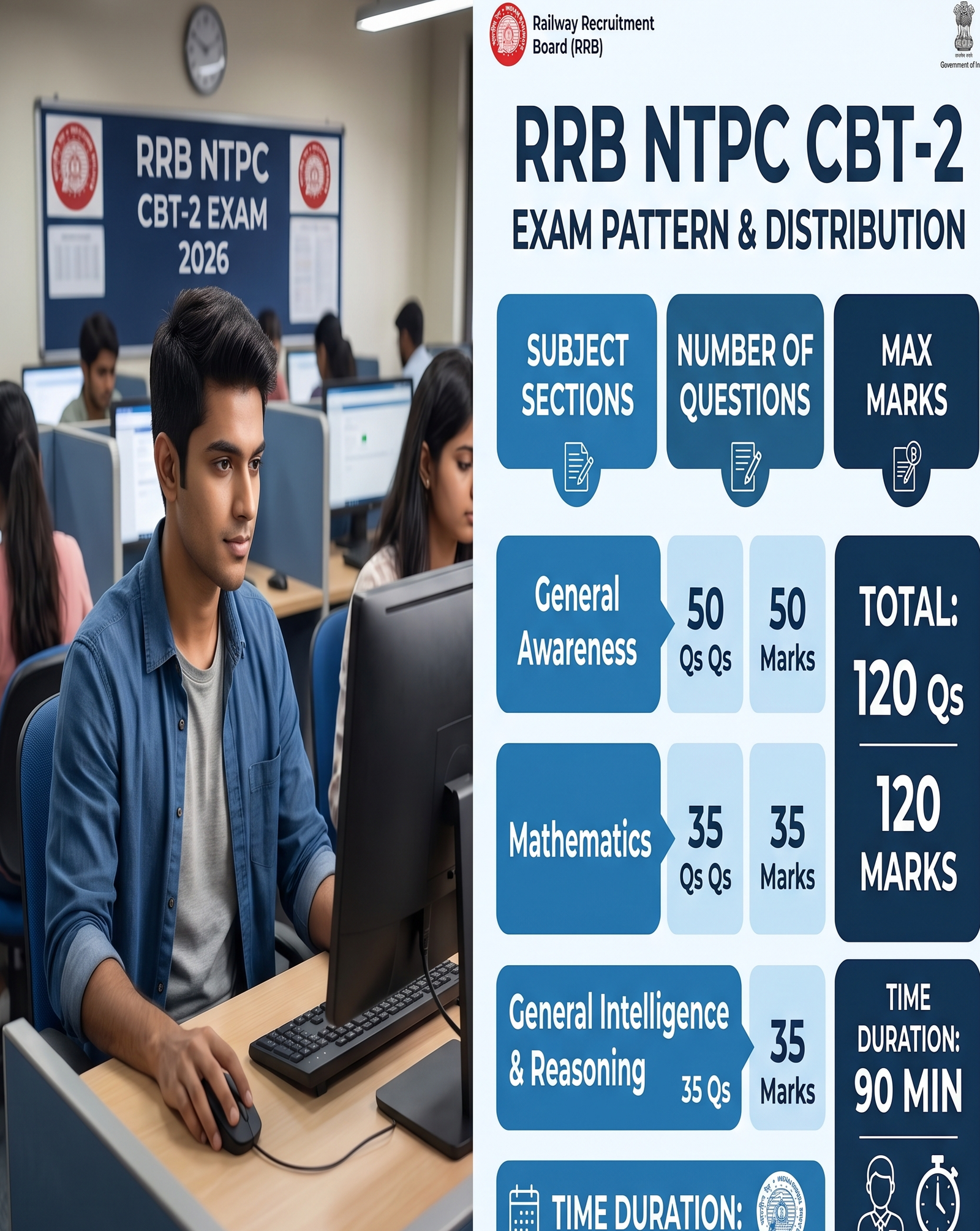
- Total Questions: 120
- Duration: 90 minutes
- Negative Marking: 1/3rd mark deducted for each incorrect answer
- Mode: Online (Computer Based Test)
- Sections covered: General Awareness, Mathematics, and General Intelligence & Reasoning — the same broad subjects as CBT-1, but assessed at a higher difficulty level
Section-Wise Approximate Distribution
- General Awareness – Around 50 questions (current affairs, static GK, science, sports, economy)
- Mathematics – Around 35 questions (arithmetic, algebra, geometry, data interpretation)
- General Intelligence & Reasoning – Around 35 questions (analogies, puzzles, coding-decoding, syllogism)
Persons with Benchmark Disabilities (PwBD) candidates are usually given extra time as per government guidelines — check your specific admit card for compensatory time allotment.
Subject-Wise Preparation Strategy
1. General Awareness — The Game Changer
GA is often the section that separates qualifiers from the rest, because it’s the most unpredictable yet the most scoring if you’re consistent.
- Read a daily current affairs digest (last 6 months minimum)
- Focus on government schemes, railway-related news, sports events, awards, and important days
- Revise static GK: Indian history, geography, polity, and general science basics
- Practical example: If a question asks about a recent railway infrastructure project (like a new Vande Bharat route or Kavach safety system rollout), a candidate who reads railway news weekly will answer in seconds — while others guess.
2. Mathematics — Speed with Accuracy
CBT-2 maths questions are often two steps deeper than CBT-1.
- Master shortcuts for percentage, ratio, time-speed-distance, and profit-loss
- Practice Data Interpretation (DI) sets daily — these often appear in clusters of 3-5 questions
- Don’t skip mensuration, algebra, and trigonometry basics — they’re commonly tested
3. General Intelligence & Reasoning — Pattern Recognition
- Practice puzzles, seating arrangements, and syllogisms daily
- Work on non-verbal reasoning (mirror images, paper folding, series)
- Time yourself — reasoning questions should ideally take under 40-45 seconds each
Step-by-Step Study Plan (30 Days Before Exam)
Days 1–10: Foundation Revision
- Revise all topics from your CBT-1 preparation
- Identify weak areas using a diagnostic mock test
- Start a daily current affairs habit (15-20 minutes)
Days 11–20: Topic-Wise Practice
- Solve topic-wise question banks (focus on higher difficulty CBT-2 level problems)
- Take 2-3 sectional tests per week
- Maintain an error log — note down mistakes and revisit them weekly
Days 21–28: Full-Length Mock Tests
- Attempt at least 8-10 full mock tests under timed conditions
- Analyze each mock thoroughly — accuracy matters more than attempt count
- Work on time management: aim to complete the exam in 75 minutes, leaving buffer time for review
Days 29–30: Light Revision + Rest
- Revise formula sheets, important dates, and current affairs notes
- Avoid learning new topics
- Get proper sleep — exam-day alertness matters more than last-minute cramming
Tips and Best Practices
- Attempt easy questions first — this builds confidence and saves time for tougher ones. As exam experts often advise, focus on time management and attempt easy questions first in the exam.
- Don’t guess blindly — with 1/3rd negative marking, random guessing can hurt your score more than leaving a question blank.
- Practice with a timer — simulate the 90-minute pressure during mock tests, not just on exam day.
- Carry the right documents — Aadhaar card, admit card, and a passport-size photo are essentials. Some centers conduct biometric verification, so Aadhaar-linked biometric authentication will be conducted at the exam center prior to entry.
- Reach the center early — at least 60-90 minutes before reporting time to avoid last-minute stress.
Common Mistakes to Avoid
- Ignoring current affairs revision — many candidates focus only on static GK and lose easy marks on recent events.
- Overconfidence after CBT-1 — CBT-2’s higher difficulty catches many off guard.
- Skipping mock test analysis — taking tests without reviewing mistakes wastes the exercise.
- Last-minute syllabus changes — not checking the official admit card for shift timing, exam city, or instructions.
- Poor time allocation — spending too long on one tough question and rushing through easier ones later.
Latest Updates and Trends
- The Railway Recruitment Boards have been increasingly relying on online city intimation slips and digital admit cards, so candidates must regularly check their registered email and RRB regional websites.
- The Ministry of Railways, through the RRBs, issued CEN No 06/2025 with the tentative schedule for the 2nd Stage CBT for Non-Technical Popular Categories (Graduate) — always refer to your zone’s official RRB website for the most accurate, region-specific updates.
- For the next recruitment cycle, RRB NTPC 2026 notification is likely to be released in August, so candidates planning future attempts should start early preparation.
Key Takeaways
- RRB NTPC Graduate CBT-2 2026 is scheduled for 10 July 2026, with admit cards out on 6 July and city slips on 1 July.
- The exam is 90 minutes, 120 questions, with 1/3rd negative marking.
- Focus areas: General Awareness (current affairs heavy), Mathematics (DI and shortcuts), and Reasoning (speed + accuracy).
- A structured 30-day plan with mock tests and error analysis significantly boosts your score.
- Always verify your exam city, shift, and instructions directly from your admit card.
Conclusion
CBT-2 is your final written gateway before document verification and medical examination. The syllabus overlap with CBT-1 means you’re not starting from scratch — but the increased difficulty demands sharper accuracy and faster problem-solving. With the right balance of current affairs revision, topic-wise practice, and disciplined mock testing, you can walk into the exam hall on July 10 with genuine confidence. Stay consistent, stay updated through official RRB channels, and trust the preparation you’ve put in.
FAQs
1. What is the RRB NTPC CBT-2 exam date 2026?
The CBT-2 exam for Graduate Level posts is scheduled for 10 July 2026.
2. How many questions are there in RRB NTPC CBT-2?
CBT-2 consists of 120 questions to be solved in 90 minutes.
3. Is there negative marking in RRB NTPC CBT-2?
Yes, 1/3rd mark is deducted for every incorrect answer.
4. When will the RRB NTPC CBT-2 admit card be released?
The admit card is expected to be released on 6 July 2026.
5. Who is eligible for RRB NTPC CBT-2?
Only candidates who qualified CBT-1 and appear on the official zone-wise shortlist are eligible.
6. Is CBT-2 syllabus different from CBT-1?
The subjects are the same — General Awareness, Mathematics, and Reasoning — but CBT-2 questions are tougher.
7. What documents are required for RRB NTPC CBT-2?
Admit card, a valid photo ID (Aadhaar preferred for biometric verification), and a passport-size photograph.