Introduction
If you’re a medical graduate eyeing a prestigious government job in India’s central health services, here’s the news you’ve been waiting for: the UPSC CMS Exam 2026 is scheduled for 02 August 2026.
The Union Public Service Commission (UPSC) Combined Medical Services (CMS) Examination is one of the most sought-after competitive exams for MBBS graduates in India. It opens the door to coveted Group A and Group B posts across central government health departments — including posts in railways, armed forces, and other central ministries.
In this comprehensive guide, you’ll learn:
- The official UPSC CMS 2026 exam date and schedule
- All important dates and deadlines at a glance
- Eligibility criteria you must meet
- Exam pattern and syllabus overview
- A realistic preparation strategy to crack CMS 2026
- Common mistakes candidates make — and how to avoid them
Let’s get started.
Table of Contents
- What Is the UPSC CMS Exam?
- UPSC CMS Exam Date 2026 — Official Schedule
- All Important Dates at a Glance
- Eligibility Criteria
- Exam Pattern & Syllabus Overview
- Recruitment Posts & Vacancies
- Step-by-Step Preparation Strategy
- Best Books & Resources
- Common Mistakes to Avoid
- Key Takeaways
- FAQs
1. What Is the UPSC CMS Exam?
The UPSC Combined Medical Services (CMS) Examination is conducted annually by the Union Public Service Commission to recruit medical officers for various central government services. Unlike other UPSC exams, CMS is exclusively for candidates who hold an MBBS degree (or equivalent).
Why Is CMS a Big Deal?
- It is the only UPSC exam specifically for medical graduates
- Selected candidates get Group A & Group B Gazetted posts in central services
- It offers job security, pay scale, and career growth comparable to top government positions
- Selected officers work in departments like Railways, Army Medical Corps, Central Health Services, and more
The exam has two written papers followed by a personality test (interview) — making it a well-rounded assessment of both medical knowledge and professional aptitude.
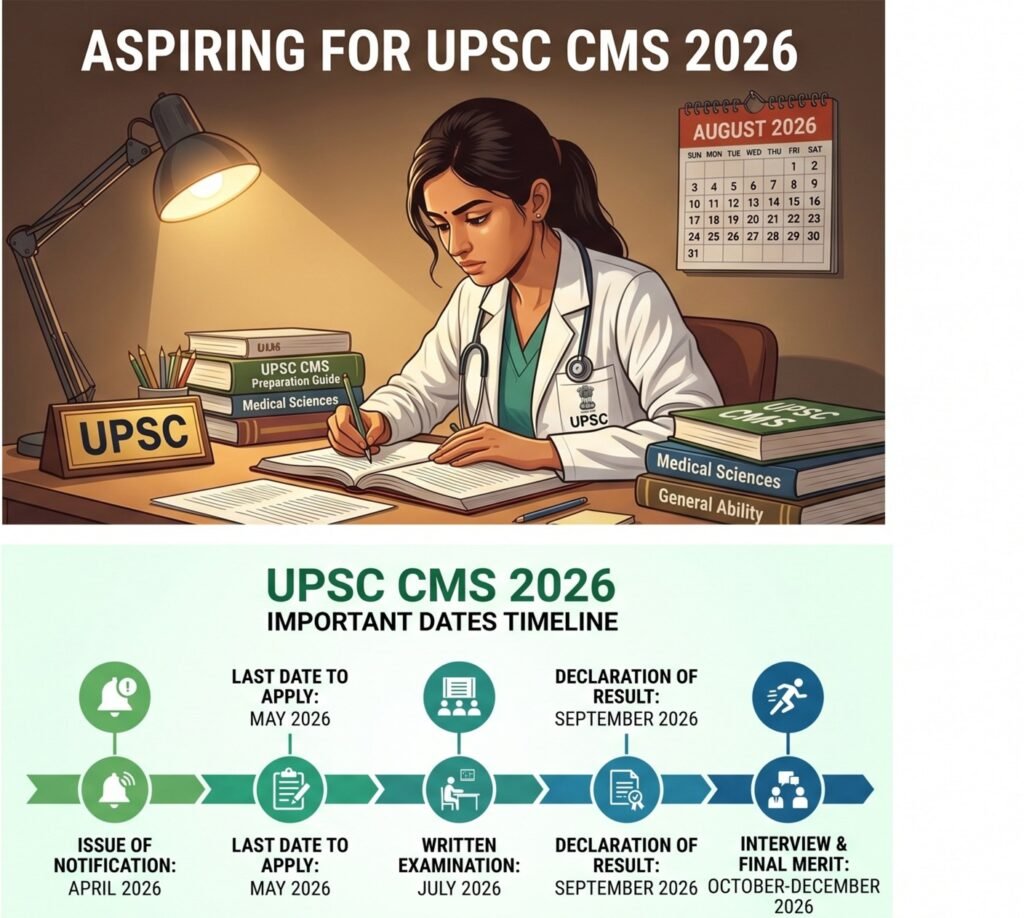
2. UPSC CMS Exam Date 2026 — Official Schedule
UPSC CMS Written Examination Date: 02 August 2026 (Sunday)
The exam will be held at various centres across India in a single-day, two-session format:
| Session | Time | Paper |
|---|---|---|
| Morning Session | 10:00 AM – 12:00 PM | Paper I |
| Afternoon Session | 2:00 PM – 4:00 PM | Paper II |
Both papers are objective-type (MCQ) with a total duration of 2 hours each.
Candidates must download their admit cards from the official UPSC website (upsc.gov.in) approximately 3 weeks before the exam.
3. All Important Dates at a Glance
Here is a complete timeline of critical dates for UPSC CMS 2026:
| Event | Expected Date |
|---|---|
| Official Notification Release | February – March 2026 |
| Online Application Opens | February – March 2026 |
| Last Date to Apply | ~March 2026 (check official notice) |
| Application Withdrawal Window | ~April 2026 |
| Admit Card Download Begins | ~July 2026 |
| Written Exam (Paper I & II) | 02 August 2026 |
| Result of Written Exam | October – November 2026 |
| Personality Test / Interview | December 2026 – January 2027 |
| Final Merit List & Appointment | Early 2027 |
Important: Always verify dates on the official UPSC website — upsc.gov.in. Dates are subject to change based on UPSC notifications.
4. Eligibility Criteria
Before you fill out the application, make sure you meet all of the following criteria. Missing even one can lead to rejection.
4.1 Educational Qualification
- Must hold an MBBS degree from a university recognised by the Medical Council of India (MCI) / National Medical Commission (NMC)
- Candidates who have completed their MBBS internship by the date of interview are eligible
- Candidates in their final year MBBS may also apply, subject to completing internship before the personality test
4.2 Age Limit
| Category | Maximum Age |
|---|---|
| General (UR) | 32 years |
| OBC | 35 years (3-year relaxation) |
| SC/ST | 37 years (5-year relaxation) |
| Ex-Servicemen | As per UPSC rules |
| PwBD | Additional relaxation applicable |
Age is calculated as on 01 January 2026.
4.3 Nationality
Applicants must be:
- A citizen of India, or
- A subject of Nepal or Bhutan, or
- A Tibetan refugee who came to India before 1962 with intention to permanently settle
4.4 Medical Fitness
- Candidates must be physically and mentally fit as per standards prescribed in the relevant recruitment rules
- Final appointment is subject to a satisfactory medical examination
5. Exam Pattern & Syllabus Overview
5.1 Exam Pattern
| Detail | Paper I | Paper II |
|---|---|---|
| Type | Objective (MCQ) | Objective (MCQ) |
| Duration | 2 Hours | 2 Hours |
| Total Marks | 250 | 250 |
| Number of Questions | 120 | 120 |
| Negative Marking | Yes (1/3 mark) | Yes (1/3 mark) |
Total Written Exam: 500 marks + Interview: 100 marks = Grand Total: 600 marks
5.2 Syllabus at a Glance
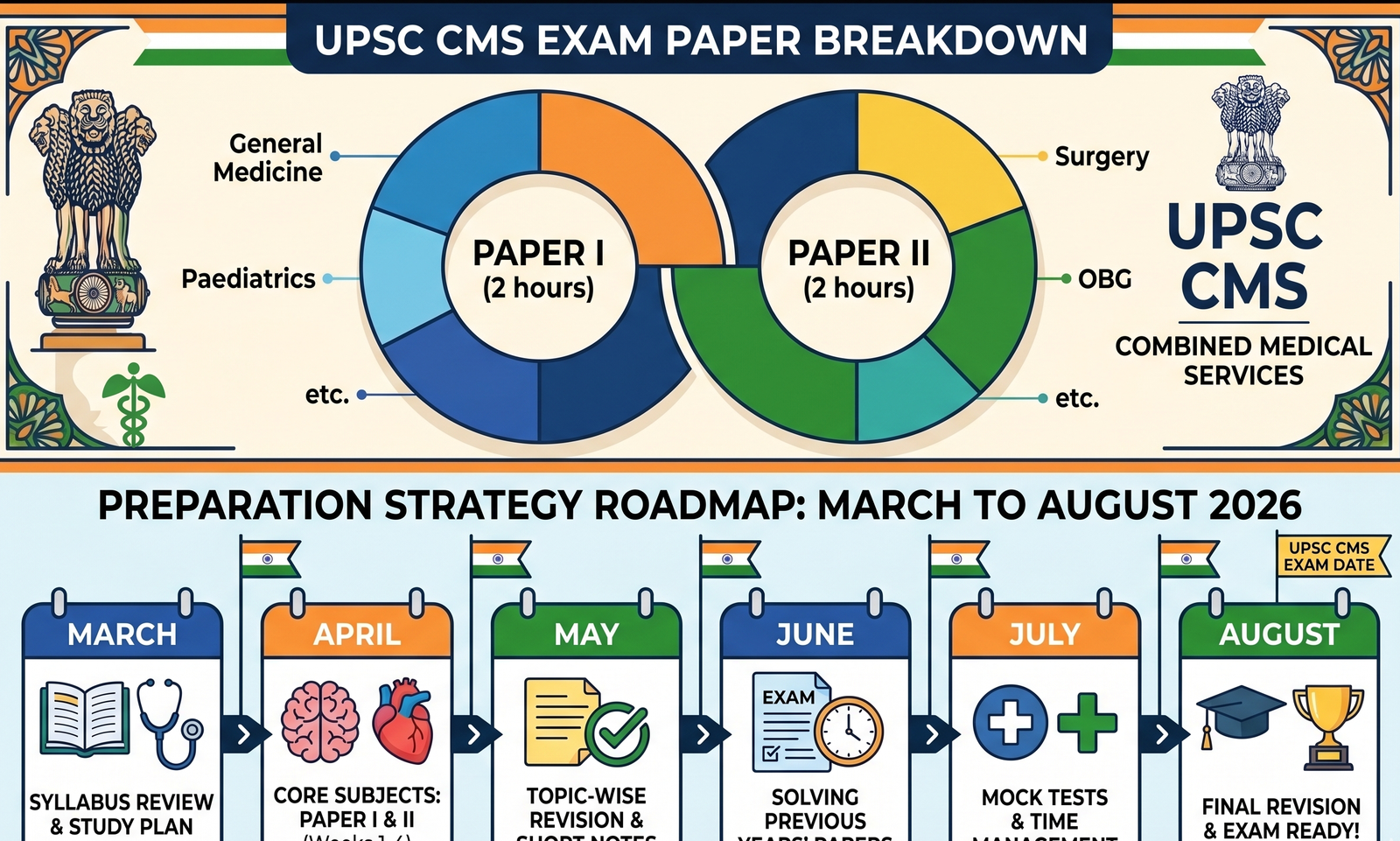
Paper I covers:
- General Medicine
- Paediatrics
Paper II covers:
- Surgery
- Gynaecology & Obstetrics
- Preventive & Social Medicine (PSM / Community Medicine)
The personality test (interview) carries 100 marks and assesses:
- Professional knowledge
- Communication skills
- Mental alertness
- Ethical and analytical thinking
6. Recruitment Posts & Vacancies
UPSC CMS recruits officers for the following services:
- Central Health Services (CHS) — General Duty Medical Officers
- Railway Medical Service
- Central Armed Police Forces (CAPF) — Assistant Divisional Medical Officers
- Military Nursing Service (for eligible candidates)
- New Delhi Municipal Council (NDMC)
- East Delhi Municipal Corporation
Vacancies vary each year. Typically, 300–500+ posts are notified. Check the official notification for 2026-specific vacancy details.
7. Step-by-Step Preparation Strategy
You have roughly 4–5 months from now to the exam on 02 August 2026. Here’s how to use that time wisely.
Step 1: Understand the Syllabus Thoroughly
Before touching a single book, download the official syllabus from UPSC’s website. Mark high-weightage topics in each subject. Prioritise General Medicine and PSM — these are the highest-scoring areas.
Step 2: Build a Subject-Wise Study Plan
Divide your preparation into phases:
- Phase 1 (Months 1–2): Cover core theory — Medicine, Surgery, Obs & Gynae, Paediatrics
- Phase 2 (Month 3): Deep dive into PSM and revision of clinical subjects
- Phase 3 (Months 4–5): Full-length mock tests, previous year papers, and rapid revision
Step 3: Practice Previous Year Question Papers
UPSC CMS has a predictable pattern — questions from previous years often repeat in modified forms. Solve at least 10 years of past papers topic-by-topic.
Step 4: Attempt Mock Tests Regularly
Start taking full-length mock tests from Month 3. Aim for at least 2 mocks per week in the final 6 weeks. Track your accuracy and time management.
Step 5: Revise Short Notes
Maintain concise, handwritten notes for each subject. Focus on:
- Diagnostic criteria
- Drug dosages
- WHO/government health targets (critical for PSM)
- Recent health policy updates
Step 6: Prepare for the Interview
Don’t neglect the personality test — it carries 100 marks. Work on:
- Current affairs in health and medicine
- Ethical scenarios in clinical practice
- Clear and confident communication
8. Best Books & Resources
| Subject | Recommended Resource |
|---|---|
| General Medicine | Harrison’s (abridged) + Davidson’s |
| Surgery | Bailey & Love (essential chapters) + SRB’s Manual |
| Obstetrics & Gynaecology | Dutta’s OBS + Shaw’s Gynae |
| Paediatrics | Nelson’s (key chapters) + OP Ghai |
| PSM / Community Medicine | Park’s Textbook of PSM |
| Previous Year Papers | Across publishers — UPSC CMS MCQ books |
| Online Practice | DAMS, MAHE, or similar UPSC CMS prep platforms |
9. Common Mistakes to Avoid
Many serious candidates lose marks — or their opportunity — due to avoidable errors.
Mistake 1: Ignoring PSM
PSM (Community Medicine) is often underestimated. In reality, it is one of the most scoring sections if studied systematically. Don’t leave it for last.
Mistake 2: Not Managing Negative Marking
With 1/3 negative marking, random guessing is risky. Attempt a question only when you’re at least 60–70% confident.
Mistake 3: Skipping Mock Tests
Reading without testing yourself is the fastest way to fail. Mocks help you simulate exam pressure, reveal weak areas, and improve time management.
Mistake 4: Applying Without Checking Eligibility
Every year, candidates apply without verifying their internship completion date or age relaxation category — and get disqualified at the verification stage.
Mistake 5: Relying on One Source
Cross-reference important facts across standard textbooks, especially for drug doses, statistical data in PSM, and surgical indications.
Key Takeaways
- UPSC CMS 2026 Written Exam Date: 02 August 2026
- The exam has two papers of 250 marks each, followed by a 100-mark interview
- Eligibility requires an MBBS degree with completed or near-completed internship
- Maximum age is 32 years for General category (with relaxations for OBC/SC/ST)
- Start preparation now — 4–5 months of structured study is sufficient to crack the exam
- Always cross-check dates and notifications on the official UPSC website: upsc.gov.in
Conclusion
The UPSC CMS 2026 exam is a golden opportunity for MBBS graduates to secure a prestigious, stable, and well-paying central government post. With the written examination set for 02 August 2026, now is the perfect time to start your preparation with a clear strategy.
Focus on high-yield subjects, practice aggressively with past papers and mocks, and don’t underestimate the power of smart revision. Whether you’re a fresh MBBS graduate or a repeat aspirant, a disciplined 4–5 month plan can absolutely make the difference.
Start today. Your medical career in central government service is 02 August 2026 away.
FAQs
Q1. What is the UPSC CMS Exam Date 2026?
The UPSC CMS Written Examination 2026 is scheduled for 02 August 2026 (Sunday), with Paper I in the morning (10 AM–12 PM) and Paper II in the afternoon (2 PM–4 PM).
Q2. Who is eligible to apply for UPSC CMS 2026?
Candidates must hold an MBBS degree (or be in the final year) from a recognised university. The maximum age is 32 years for the general category as on 01 January 2026, with relaxations for reserved categories.
Q3. How many marks does the UPSC CMS exam carry in total?
The total marks are 600 — 500 for the written examination (Paper I: 250 + Paper II: 250) and 100 for the personality test (interview).
Q4. Is there negative marking in UPSC CMS 2026?
Yes. There is a negative marking of 1/3 of the marks allotted to each question for every wrong answer.
Q5. What subjects are covered in UPSC CMS Paper I and Paper II?
Paper I covers General Medicine and Paediatrics. Paper II covers Surgery, Gynaecology & Obstetrics, and Preventive & Social Medicine (PSM).
Q6. How many posts are typically filled through UPSC CMS?
UPSC generally notifies 300–500+ vacancies for various central government health services posts each year. The exact number for 2026 will be in the official notification.
Q7. Where can I download the UPSC CMS 2026 admit card?
Admit cards are available on the official UPSC website — upsc.gov.in — approximately 3 weeks before the examination date.