Introduction
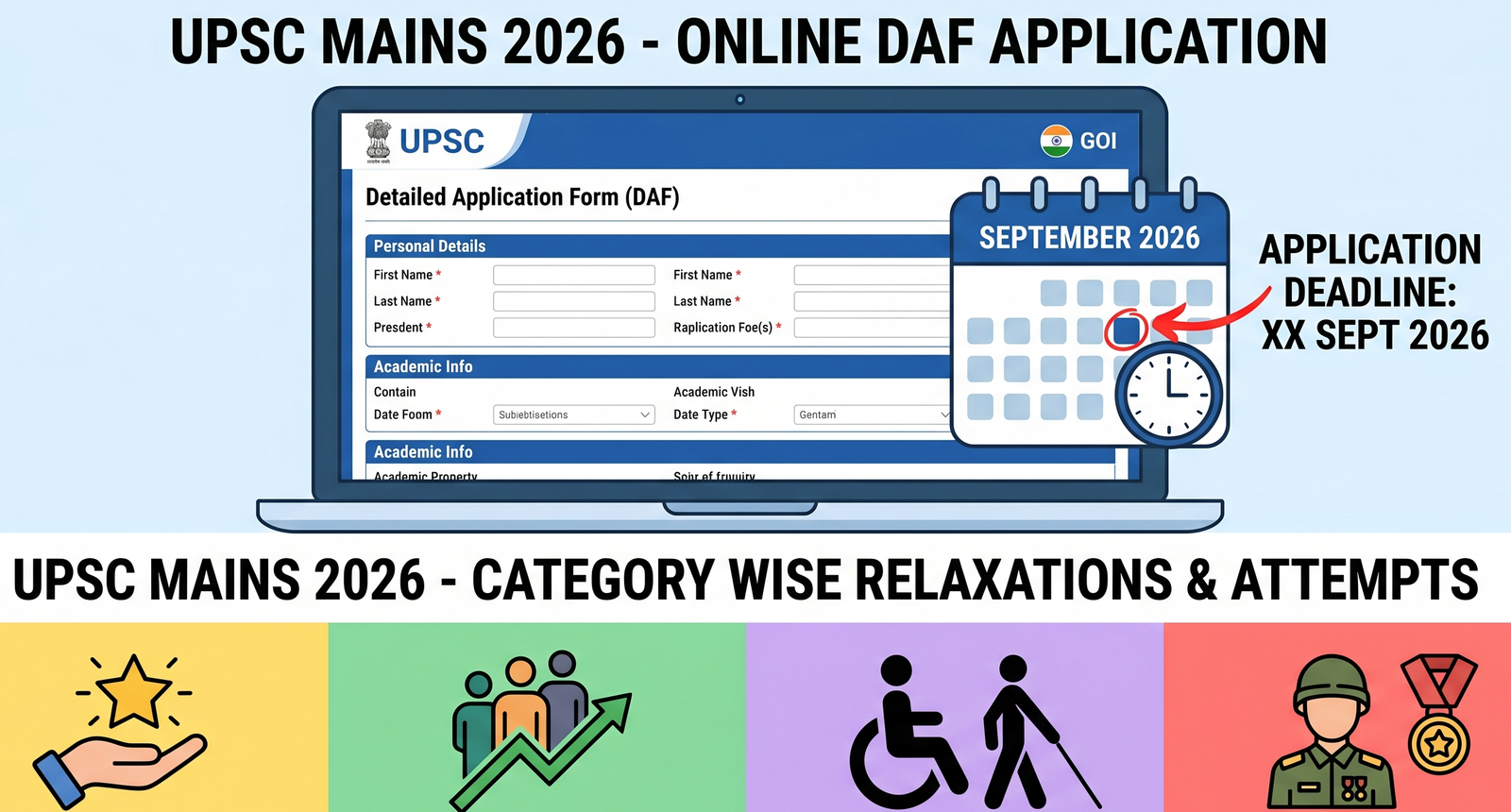
If you cleared UPSC Prelims 2026, the real race has just begun — and right now, the most urgent task on your desk is the UPSC Civil Services IAS Mains Online Form 2026. The application link went live on 19 June 2026, and the window closes on 29 June 2026. Miss this date, and there’s no second chance, no matter how hard you’ve worked for Prelims.
This guide walks you through everything you need: the exact dates, eligibility rules, step-by-step form-filling process, document checklist, common mistakes candidates make, and a realistic preparation roadmap for the two months leading up to the Mains exam on 21 August 2026. Whether you’re a first-time aspirant or a repeat candidate fine-tuning your strategy, this article gives you the practical, no-fluff information you actually need.
Table of Contents
- What Is the UPSC Civil Services Mains Exam 2026?
- UPSC Mains 2026 Important Dates
- Eligibility Criteria
- Step-by-Step Guide to Fill the Mains Form
- Application Fee Details
- Documents You’ll Need
- DAF (Detailed Application Form) — What It Means
- Common Mistakes to Avoid
- Preparation Strategy for the Next 60 Days
- Latest Updates and Trends for UPSC 2026
- Key Takeaways
- Conclusion
- FAQs
1. What Is the UPSC Civil Services Mains Exam 2026?
The UPSC Civil Services Examination is conducted in three stages: Preliminary, Mains, and Interview (Personality Test). Only candidates who clear the Prelims cut-off are invited to fill the Mains application — this is called the Detailed Application Form (DAF-I).
The Mains exam tests depth, not just recall. It includes nine descriptive papers — Essay, four General Studies papers, two Optional Subject papers, and two qualifying language papers — designed to evaluate analytical thinking, writing ability, and command over a chosen subject. This stage decides who moves on to the interview round and, eventually, who gets a service allocation in IAS, IPS, IFS, or one of the other Central Civil Services.
2. UPSC Mains 2026 Important Dates
Here’s the complete timeline candidates should track closely:
| Event | Date |
|---|---|
| UPSC Prelims 2026 Exam | 24 May 2026 |
| Mains Online Form (DAF) Activation | 19 June 2026 |
| Last Date to Submit Mains Form | 29 June 2026 |
| UPSC Mains 2026 Exam | Starting 21 August 2026 (5 days) |
| Mains Admit Card Release | Around 15–20 days before the exam |
A few points worth noting:
- The Mains form is only for candidates who cleared the Prelims cut-off. There’s no separate notification — UPSC directly emails or messages qualified candidates, but it’s safer to check your status yourself on the official portal rather than wait for a notification.
- The exam window typically spans five days, so plan personal leave, travel, and accommodation early — hotel and travel costs near exam centers spike close to the date.
- Always cross-check dates on upsc.gov.in or upsconline.nic.in, since UPSC occasionally extends deadlines by a day or two due to technical issues.
3. Eligibility Criteria
Eligibility for the Mains stage mirrors the original Prelims notification, but it’s worth re-confirming before you submit the form.
Age Limit
- Minimum Age: 21 years
- Maximum Age: 32 years (for the General category)
- Candidates must be born not earlier than 2 August 1994 and not later than 1 August 2005
Age Relaxation (as per standard UPSC norms)
- OBC: up to 3 years
- SC/ST: up to 5 years
- PwBD candidates: up to 10 years
- Additional relaxations apply for defence personnel, ex-servicemen, and certain J&K domicile candidates for specific exam years
Educational Qualification
- A degree from a recognized university, or an equivalent qualification recognized by the Government of India
- Final-year students awaiting results can apply provisionally, but must produce proof of having passed the qualifying exam at the time of DAF submission
Number of Attempts
- General: 6 attempts
- OBC: 9 attempts
- SC/ST: Unlimited attempts (within the age limit)
- PwBD: Relaxed attempt limits as per category
Practical tip: Many candidates assume the Mains form has separate eligibility from Prelims — it doesn’t. If you had any discrepancy in your Prelims application (like a category certificate issue), resolve it now, because DAF scrutiny is far stricter than Prelims scrutiny.
4. Step-by-Step Guide to Fill the Mains Form
- Visit the official portal: Go to upsconline.nic.in and log in using your existing One-Time Registration (OTR) credentials — you don’t need to register again.
- Check qualification status: Only Prelims-qualified candidates can access the Mains DAF link.
- Fill Part I of DAF: Enter personal details, communication address, and confirm your photograph/signature uploaded earlier.
- Select your Optional Subject: This is one of the most important choices in the entire exam — choose carefully based on your background, interest, and availability of study material.
- Choose exam centre: Pick from the list of available Mains centres; options are usually fewer than Prelims centres, so check availability early.
- Fill service and cadre preferences (if applicable): Some cycles allow preliminary preference filling at this stage; follow the on-screen instructions exactly.
- Upload required documents: Category certificate, PwBD certificate, or other relevant proofs if applicable.
- Review and submit: Double-check every field — once submitted, corrections are extremely limited or not allowed at all for Mains.
- Download and save confirmation: Always save a PDF copy of your submitted DAF for your records.
Practical example: A candidate from Lucknow applying for the first time should keep scanned copies of their graduation degree, category certificate (if applicable), and a recent passport-size photo ready before starting the form — this alone saves 30–40 minutes of last-minute scrambling.
5. Application Fee Details
- General/EWS/OBC candidates: ₹100
- SC/ST/PwBD/Women candidates: No fee
- Payment can be made online via net banking, debit/credit card, or through SBI challan at designated branches (cash mode, where applicable)
Fee once paid is non-refundable, so verify all your details before making the payment.
6. Documents You’ll Need
Keep these ready in scanned, UPSC-compliant format before you start:
- Recent passport-size photograph (as per UPSC’s prescribed size and format)
- Scanned signature
- Graduation degree / provisional certificate
- Category certificate (SC/ST/OBC-NCL, if applicable)
- PwBD certificate (if applicable)
- Ex-servicemen certificate (if applicable)
- Valid ID proof (Aadhaar, PAN, passport, etc.)
7. DAF — What It Really Means
The Detailed Application Form (DAF) isn’t just a formality — it’s the document UPSC interview boards use to ask you personal questions later. Every detail you fill here, from your hobbies to your work experience, can become an interview question months later.
Insight from successful candidates: Treat the DAF as a mini-introduction to your interview board. Don’t list hobbies or achievements you can’t speak confidently about — interview panels often probe exactly these details.
8. Common Mistakes to Avoid
- Waiting until the last day: Server load spikes in the final 24–48 hours, causing failed submissions. Apply at least 3–4 days early.
- Choosing the wrong optional subject under pressure: Don’t pick an optional just because a friend is scoring well in it — match it to your own strengths.
- Mismatched details between Prelims and Mains forms: Even minor spelling differences in your name or date of birth can trigger DAF scrutiny issues later.
- Ignoring document format guidelines: Photos or signatures that don’t match UPSC’s size/format specs often get rejected during upload.
- Not saving the confirmation page: Always download your final submitted form — UPSC support requests often need this as proof.
- Forgetting to verify exam centre availability: Mains centres fill up; if your preferred city isn’t selectable, you may be allotted a distant centre.
9. Preparation Strategy for the Next 60 Days
With roughly two months between the form submission and the actual exam, structure your time wisely:
Weeks 1–3: Foundation and Optional Subject
- Revise your optional subject syllabus thoroughly — this carries 500 marks (two papers of 250 each)
- Start daily answer writing practice, even if it’s just 2–3 questions a day
Weeks 4–6: General Studies Deep Dive
- Focus on GS papers (Governance, Ethics, Economy, International Relations, Environment)
- Use current affairs from the last 12 months — link them to static syllabus topics
Weeks 7–8: Mock Tests and Revision
- Join a structured Mains test series for at least 8–10 full-length mocks
- Get answers evaluated by mentors or peer groups — self-evaluation alone won’t reveal blind spots
- Revise the Essay paper separately; many candidates underprepare for it
Daily Habits That Matter
- Newspaper reading focused on editorial analysis, not just headlines
- Answer writing under timed conditions (this builds speed for the actual 3-hour papers)
- Short daily revision of static portions (Polity, Geography, History) to avoid last-minute cramming
10. Latest Updates and Trends for UPSC 2026
- UPSC has introduced a post-Mains service preference updation window, meaning candidates can now reorder or update their service (IAS/IPS/IFS, etc.) preferences only after Mains results are declared — a shift from earlier cycles where preferences were locked early.
- The number of vacancies and exact post breakdown can change slightly between the Prelims and Mains notifications, so always check the latest official advertisement number for confirmed figures.
- UPSC continues to push candidates toward the One-Time Registration (OTR) system, which now carries forward across Prelims and Mains, reducing repetitive data entry.
Key Takeaways
- The UPSC Mains 2026 form window is 19 June to 29 June 2026 — apply early to avoid server issues.
- Eligibility age is 21–32 years, with standard category-based relaxations.
- Application fee is ₹100 for General/OBC/EWS; free for SC/ST/PwBD/Women.
- The DAF is more than paperwork — it shapes your interview later, so fill it thoughtfully.
- Use the remaining weeks for focused answer writing and mock tests rather than passive reading.
Conclusion
The UPSC Civil Services Mains Online Form 2026 is a narrow but critical window — ten days that decide whether your months of Prelims preparation translate into a real shot at the services. Fill the form carefully, keep your documents ready, and don’t leave submission to the last moment. More importantly, use the weeks between now and the Mains exam on 21 August 2026 wisely: prioritize answer writing, revise your optional subject, and stay consistent with current affairs. Civil services success rarely comes from cramming in the final week — it comes from steady, focused preparation starting today.
FAQs
1. What is the last date to fill the UPSC Civil Services Mains Online Form 2026? The last date to submit the UPSC Mains 2026 application is 29 June 2026, with the window having opened on 19 June 2026.
2. Who is eligible to fill the UPSC Mains 2026 form? Only candidates who have qualified the UPSC Prelims 2026 exam (held on 24 May 2026) and meet the age and educational eligibility criteria can apply for the Mains stage.
3. What is the application fee for UPSC Mains 2026? General, OBC, and EWS candidates must pay ₹100, while SC, ST, PwBD, and women candidates are exempt from the fee.
4. When will the UPSC Mains 2026 exam be conducted? The UPSC Civil Services Mains Exam 2026 is scheduled to begin on 21 August 2026 and will continue over five days.
5. Can I change my optional subject after submitting the Mains form? No, once the DAF is submitted, changes to the optional subject are generally not permitted, so choose carefully before final submission.
6. What documents are required for the UPSC Mains 2026 application? You’ll need a recent photograph, signature, graduation certificate, category certificate (if applicable), PwBD/ex-servicemen certificate (if applicable), and a valid ID proof.
7. Where can I check my UPSC Mains 2026 eligibility status? Eligibility status is visible after logging into your OTR account on upsconline.nic.in; only Prelims-qualified candidates can access the Mains DAF link.