Introduction
If you applied for the CBSE Group A, B, and C recruitment drive and cleared the earlier stages, you’re probably refreshing the CBSE website every few hours right now, waiting for one thing: your exam city slip for the Skill Test.
That waiting game ends here. This guide walks you through everything connected to the CBSE Group A, B, C Skill Test Exam City Details 2026 — how to check it, what dates to keep in mind, who is eligible for the skill test stage, and the small mistakes that trip up otherwise well-prepared candidates every year.
By the end of this article, you’ll know exactly where to click, what documents to keep ready, and how to walk into your typing/skill test centre with zero last-minute panic.
Table of Contents
- What Is the CBSE Group A, B, C Skill Test?
- Why the Exam City Detail Matters
- Who Needs to Appear for the Skill Test
- Important Dates at a Glance
- Eligibility Criteria
- Step-by-Step: How to Check Your Exam City Details
- Documents to Carry on Test Day
- Tips to Prepare for the Skill/Typing Test
- Common Mistakes Candidates Make
- Latest Updates and Trends
- Key Takeaways
- Conclusion
- FAQs
1. What Is the CBSE Group A, B, C Skill Test?
The Central Board of Secondary Education (CBSE) conducts recruitment for various administrative and academic posts under Group A, B, and C categories — including Assistant Secretary, Accounts Officer, Superintendent, Junior Translation Officer, Junior Accountant, and Junior Assistant.
The selection process runs in stages: Tier-I (objective screening), Tier-II (for select posts like Superintendent), a qualifying Skill Test, and an Interview (only for Group A roles). The Skill Test is essentially a practical check — mostly a typing test — for posts where day-to-day work involves data entry, correspondence, and computer-based recordkeeping.
It doesn’t add marks to your final score, but it’s a make-or-break qualifying hurdle. Miss the benchmark speed, and your Tier-I or Tier-II performance won’t save you.
2. Why the Exam City Detail Matters
Before the admit card arrives, CBSE releases an Exam City Intimation Slip — a short document confirming only the city (not the exact venue) where your test will happen. This isn’t a formality. It exists so candidates can:
- Book train or flight tickets early, before prices spike
- Arrange accommodation near the test city
- Avoid the scramble of last-minute travel planning
- Cross-check that their preferred city choice (submitted during the application) was actually allotted
Skipping this check is one of the most avoidable mistakes candidates make — some end up booking travel to the wrong city entirely, based on assumption rather than verification.
3. Who Needs to Appear for the Skill Test
The skill test isn’t mandatory for every post. Based on the official selection pattern, it applies mainly to:
- Junior Assistant
- Junior Accountant
- Senior Assistant / Stenographer categories
- Superintendent (as part of the broader Tier-I, Tier-II, Skill Test sequence)
Posts like Assistant Secretary, Assistant Professor, and Accounts Officer typically move from the written exam stage directly to interview, without a skill/typing component.
4. Important Dates at a Glance
| Event | Status/Date |
|---|---|
| Online Application Window | December 02 – December 27, 2025 |
| Application Correction Window | December 29–30, 2025 |
| Tier-I Written Exam | January 31 & February 1, 2026 |
| Tier-I Result | March 2, 2026 |
| Tier-II Exam City Slip Released | April 8, 2026 |
| Tier-II Admit Card | April 15, 2026 |
| Tier-II Exam | April 18, 19, 25 & 26, 2026 |
| Tier-II Result | May 15, 2026 |
| Skill Test / Typing Test | Expected shortly after Tier-II/Tier-I results, post-specific |
Skill Test scheduling and city-slip release dates vary by post, since not every candidate reaches this stage at the same time. Always cross-check your own login for your applicable timeline — treat the table above as a reference, not a guarantee.
5. Eligibility Criteria
General eligibility (age reckoned as on the cut-off date specified in the notification) varies by post:
- Assistant Secretary: 18–35 years
- Accounts Officer: 18–35 years
- Assistant Professor / Assistant Director: 18–30 years
- Superintendent: 18–30 years
- Junior Translation Officer: 18–30 years
- Junior Accountant: 18–27 years
- Junior Assistant: 18–27 years
For the skill test specifically, posts like Junior Assistant and Junior Accountant require a typing speed of 35 words per minute in English or 30 words per minute in Hindi on a computer. This is qualifying — you either clear the benchmark or you don’t; there’s no partial credit.
Standard age relaxation applies for SC/ST, OBC, PwBD, and other reserved categories as per government norms.
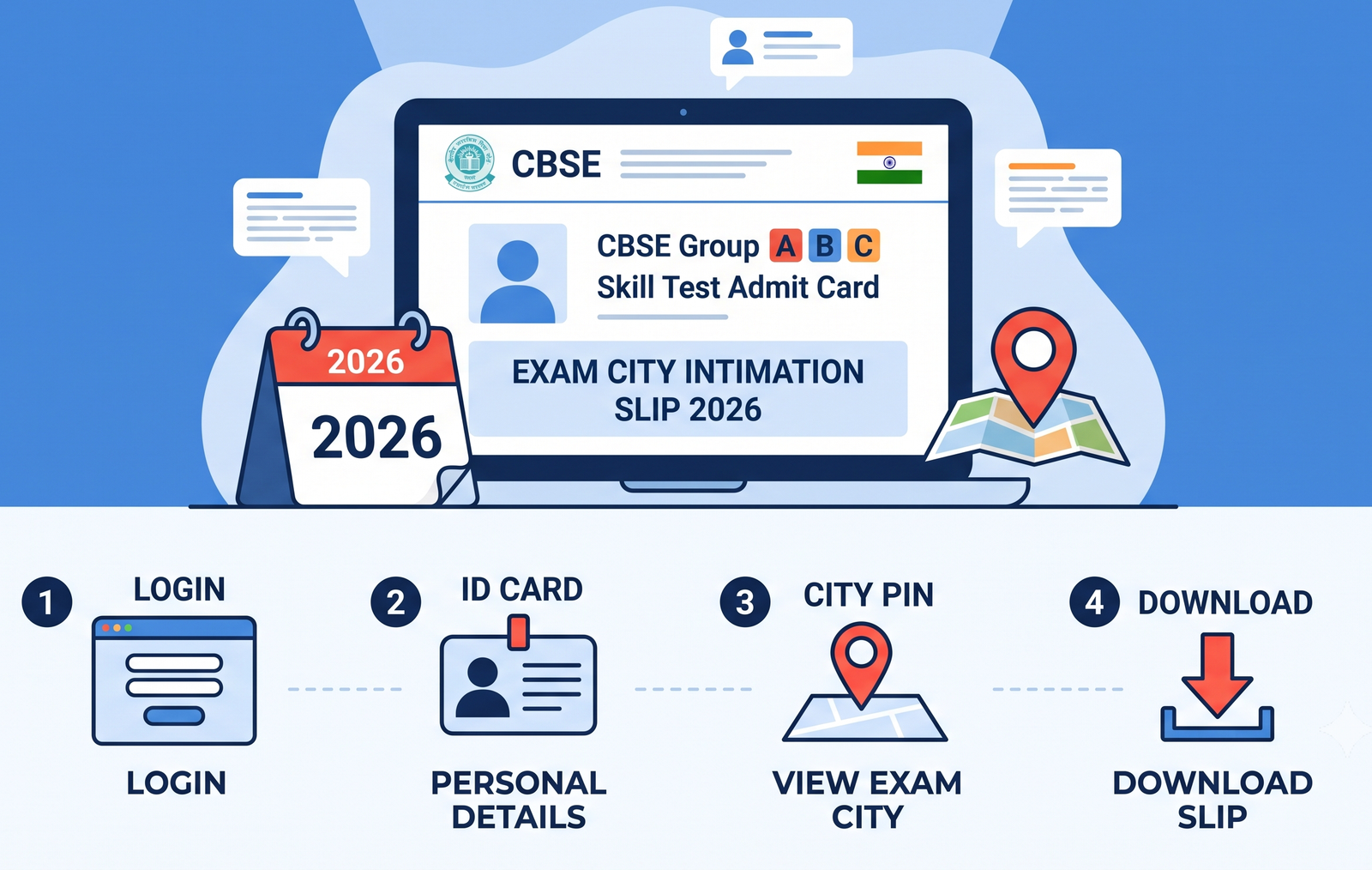
6. Step-by-Step: How to Check Your Exam City Details
- Visit the official CBSE website: cbse.gov.in
- Click on the “Recruitment” tab in the top menu.
- Find and select the relevant link — usually labelled something like “Group A, B, C Exam City / Skill Test Details 2026.”
- On the login page, enter your Application Number / Enrollment Number and Date of Birth.
- Enter the security PIN/captcha shown.
- Click Submit — your exam city (and later, your full admit card) will display on screen.
- Download the slip and save at least two copies — one digital, one printed.
Keep this simple rule in mind: the city slip tells you where to travel; only the admit card tells you which exact centre and what time. Don’t finalize local transport until the admit card is out.
7. Documents to Carry on Test Day
- Printed admit card/hall ticket
- A valid original photo ID (Aadhaar, PAN, Voter ID, or Passport)
- Passport-size photographs (same as used during application, if instructed)
- Category/PwBD certificate, if applicable
- A face mask or personal hygiene kit, if required by current centre guidelines
Carrying only the city intimation slip is not sufficient for entry — CBSE explicitly requires the admit card for gate entry.
8. Tips to Prepare for the Skill/Typing Test
- Practice on a full-size keyboard daily, not just your phone. Typing rhythm on a physical keyboard is different from touchscreen typing.
- Time yourself with 10-minute mock passages to build both speed and accuracy under pressure.
- Don’t chase speed at the cost of errors — most skill tests have an accuracy threshold alongside the words-per-minute requirement.
- Familiarize yourself with the software typically used in CBSE test centres (usually a standard DOEACC/NIELIT-style typing tool).
- Reach the centre at least 45–60 minutes early to avoid rushed, anxious typing.
9. Common Mistakes Candidates Make
- Assuming the exam city slip and admit card are the same document — they’re not.
- Waiting until the last day to download the slip, then facing server overload.
- Practicing typing only in English when the post allows a Hindi option (or vice versa), missing an easier qualifying route.
- Not verifying spelling of name/DOB on the slip — errors here can cause entry issues later.
- Ignoring SMS/email alerts from CBSE, then missing narrow correction windows.
10. Latest Updates and Trends
CBSE has increasingly moved city and admit card releases to a staggered, post-specific schedule rather than one blanket release date, since different posts reach the skill-test stage at different times. Skill test venues are typically concentrated in major hubs — cities like Delhi, Mumbai, Bengaluru, Hyderabad, Kolkata, Chennai, Pune, Lucknow, Jaipur, and Chandigarh have historically hosted the bulk of CBSE recruitment testing infrastructure, based on past cycles.
Given the qualifying (non-scoring) nature of the skill test, candidates who clear Tier-I/Tier-II with strong margins are advised not to treat the typing stage casually — disqualification here overrides a good written score entirely.
Key Takeaways
- The Skill Test is a qualifying stage — no marks are added to your final merit, but failing it ends your candidacy regardless of written exam performance.
- Only Junior Assistant, Junior Accountant, Superintendent, and similar posts require this stage.
- The exam city slip is released before the admit card — always check both separately.
- Typing benchmark: 35 wpm (English) or 30 wpm (Hindi).
- Always verify details directly on cbse.gov.in; third-party sites can carry outdated or incorrect information.
Conclusion
The CBSE Group A, B, C Skill Test stage might feel like a small technical checkpoint compared to the written exams, but it’s just as decisive. Treat the exam city slip and admit card as two separate must-check documents, keep your typing practice consistent in the weeks leading up to test day, and always confirm dates directly from the official CBSE portal. A little organization now saves you a lot of stress on exam day.
FAQs
1. Where can I check my CBSE Group A, B, C Skill Test Exam City 2026? Log in at cbse.gov.in under the “Recruitment” section using your application number and date of birth.
2. Is the CBSE Skill Test compulsory for all posts? No. It’s mainly required for Junior Assistant, Junior Accountant, and select Group C/administrative roles that involve typing or data-entry work.
3. What typing speed is required to clear the CBSE Skill Test? 35 words per minute in English or 30 words per minute in Hindi on a computer.
4. Does the Skill Test carry marks in the final merit list? No, it is qualifying in nature. You must clear the minimum benchmark, but no marks are added to your overall score.
5. Can I use the exam city slip instead of the admit card to enter the test centre? No. The city slip only confirms your city; the admit card (with centre, time, and roll number) is mandatory for entry.
6. When will the CBSE Skill Test 2026 be conducted? Skill test scheduling is post-specific and generally follows shortly after Tier-I or Tier-II results, depending on the role. Check your login for exact dates.
7. What documents should I carry to the CBSE Skill Test centre? Printed admit card, a valid photo ID proof, and any category or PwBD certificate applicable to your application.