If you’ve just finished your graduation and you’re scanning job portals every night, you’ve probably already heard the buzz: Central Bank of India has opened 4,500 apprentice vacancies for 2026, and the online exam is almost here. That’s not a small number — it’s one of the biggest apprenticeship drives in the Indian banking sector this year.
In this guide, you’ll get everything in one place: the confirmed and expected CBI Apprentice Exam Date 2026, eligibility rules explained in plain language, the exact exam pattern, and a week-by-week preparation plan you can actually follow — even if you have a full-time job or college classes right now.
Let’s get into it.
Table of Contents
- What Is the CBI Apprentice Scheme, Really?
- CBI Apprentice Exam Date 2026 — Latest Update
- Important Dates at a Glance
- Eligibility Criteria Explained
- Application Fee
- Exam Pattern & Marking Scheme
- Syllabus Breakdown (Subject by Subject)
- Step-by-Step Preparation Plan
- Tips and Best Practices
- Common Mistakes Candidates Make
- Latest Updates and Trends
- Key Takeaways
- Conclusion
- FAQs
1. What Is the CBI Apprentice Scheme, Really?
Before you prepare for any exam, it helps to know what you’re actually signing up for.
The Central Bank of India Apprentice programme runs under the Apprentices Act, 1961, in partnership with the BFSI Sector Skill Council of India (BFSI SSC). It is not a regular banking job. It’s a one-year, paid, on-the-job training programme designed to give fresh graduates real banking floor experience.
Here’s what that means practically:
- You’ll work inside an actual CBI branch, learning day-to-day banking operations.
- You’ll receive a fixed monthly stipend of ₹15,000 — but no HRA, DA, medical benefits, or leave encashment, since apprentices aren’t regular employees.
- After the 12-month period ends, there’s no automatic job guarantee. The bank is upfront about this: apprentices have no legal right to demand permanent employment afterward.
So why do thousands of graduates still apply every year? Because the experience looks strong on a resume, it builds real exposure to banking products and systems, and many candidates use this year to simultaneously prepare for IBPS, SBI, and RBI recruitment exams — turning a training stipend into a launchpad.
2. CBI Apprentice Exam Date 2026 — Latest Update
Here’s the most important part, so let’s not bury it.
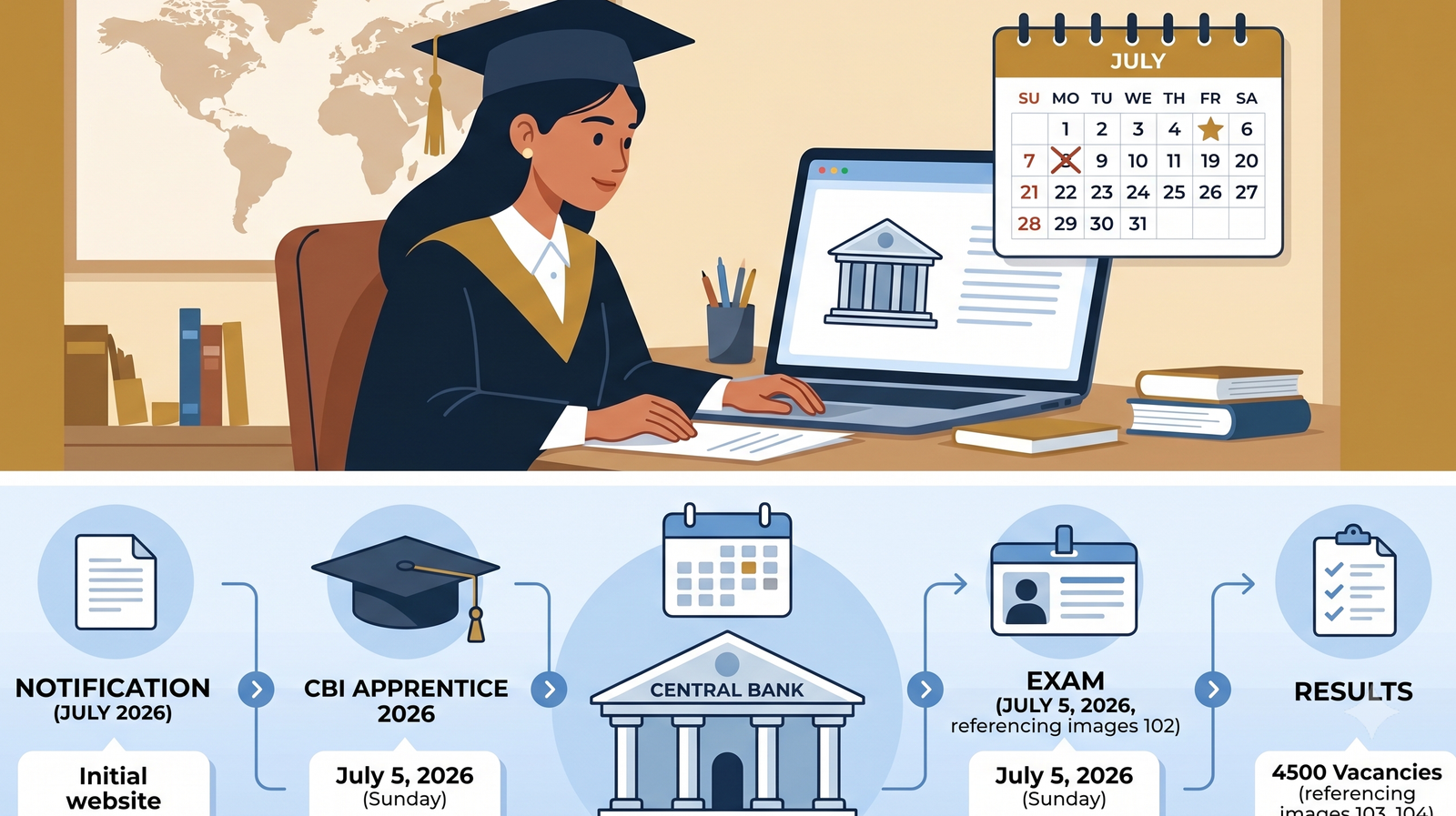
As of now, Central Bank of India has confirmed that the online examination is tentatively scheduled for the first week of July 2026. Some sources point to 1 July 2026 as the likely date, but the bank has not released a fixed, final date yet — it will be communicated through the BEEP portal (beep.bfsissc.com) and the official CBI recruitment page.
A few things worth knowing about how this exam actually works:
- This is a remote, work-from-home exam. There’s no physical exam centre and no admit card in the traditional sense — you take the test from your own device.
- Because it’s home-based, a stable internet connection and a quiet room matter just as much as your preparation.
- The exact date and time slot will be emailed to registered candidates, so keep checking your inbox (including spam folder) closer to the date.
Action step: Bookmark the official CBI recruitment page (centralbank.bank.in) and the BEEP portal, and check both every 2–3 days starting late June.
3. Important Dates at a Glance
| Event | Date |
|---|---|
| Notification released | 12 June 2026 |
| Online application starts | 12 June 2026 |
| Original application deadline | 22 June 2026 |
| Extended application deadline | 28 June 2026 |
| Eligibility cut-off date | 31 May 2026 |
| Tentative online exam | First week of July 2026 |
| Local language test | After qualifying online exam (date announced separately) |
Note: The application window has already closed based on the extended deadline, so if you registered, your focus now should be 100% on exam prep, not paperwork.
4. Eligibility Criteria Explained
Eligibility mistakes are one of the most common (and most painful) reasons candidates get disqualified late in the process. Here’s the breakdown in simple terms.
Age Limit
- You must be 20 to 28 years old as of the cut-off date.
- In terms of birth date, you should be born between 31 May 1998 and 31 May 2006.
- Age relaxation applies for reserved categories: 3 years for OBC, 5 years for SC/ST, and 10 years for PwD candidates, as per standard government norms.
Educational Qualification
- A graduation degree in any discipline from a university recognized by the Government of India.
- Your graduation must have been completed with a passing certificate obtained after 1 January 2021 — this is a firm cut-off, not a suggestion.
Who Is NOT Eligible
This part trips people up, so read carefully:
- Candidates who have already completed an apprenticeship (under any scheme) are not eligible.
- Candidates currently undergoing apprenticeship training elsewhere cannot apply.
- If you have one year or more of work experience after graduation, you’re disqualified from this scheme — it’s meant strictly for freshers.
Local Language Requirement
You must be reasonably proficient — reading, writing, speaking, and understanding — in the official language of the state you’re applying for. If you studied that language at the Class 10 or Class 12 level (and can show the marksheet), you’re exempt from the separate local language test later in the process.
Citizenship
Indian citizens are eligible, along with specific categories like Nepal/Bhutan subjects and certain persons of Indian origin who migrated from listed countries — provided they hold an eligibility certificate from the Government of India.
5. Application Fee
The fee is category-based, and GST applies on top of the base amount. General/OBC/EWS candidates typically pay a higher fee than SC/ST/PwD candidates, who get a concessional rate. Since fee structures can be revised, always verify the exact amount on the official BEEP portal before payment — and remember, once paid, the fee is non-refundable.
6. Exam Pattern & Marking Scheme
This is where your preparation strategy actually begins. Here’s the confirmed structure:
- Total Questions: 100
- Total Marks: 100
- Duration: 60 minutes
- Number of Sections: 5
- Negative Marking: None
- Medium: English/Hindi (the General English section itself will be in English only)
- Mode: Online, objective-type, taken remotely from your own device
Because there’s no negative marking, one simple rule applies: attempt every single question. Leaving a question blank costs you the same as getting it wrong — zero marks either way — so an educated guess is always better than skipping.
7. Syllabus Breakdown (Subject by Subject)
The exam covers five areas. Here’s what to expect in each, along with where to focus your energy.
A. Quantitative & Reasoning Aptitude
- Number series, simplification, percentages, ratio-proportion
- Data interpretation (tables, bar graphs, pie charts)
- Puzzles, seating arrangement, syllogism, coding-decoding
- Tip: This section eats the most time. Practice speed-solving daily rather than just accuracy.
B. General English
- Reading comprehension
- Error spotting, sentence correction
- Fill in the blanks, para jumbles, vocabulary (synonyms/antonyms)
- Tip: Read one English newspaper editorial daily — it trains both vocabulary and comprehension speed together.
C. General & Financial Awareness
- Current banking and financial news
- Government schemes, RBI policies, budget highlights
- Basic economic terms and static banking awareness
- Tip: Focus on the last 4–6 months of banking news rather than trying to cover a full year.
D. Computer Knowledge
- Basics of hardware/software, MS Office
- Internet, email, and networking fundamentals
- Banking-related computer applications (core banking systems, digital banking basics)
- Tip: This is usually the easiest-scoring section if you revise fundamentals — don’t skip it assuming it’s “too basic to study.”
E. Central Bank of India Products & Services
- Awareness of CBI’s specific banking products, savings schemes, loan products, and digital services
- Tip: This section is bank-specific, so generic banking-exam books won’t fully cover it. Visit the official CBI website’s “Products” section and skim through savings accounts, loan schemes, and digital banking offerings.
8. Step-by-Step Preparation Plan
Here’s a realistic 3-week plan, assuming the exam lands in the first week of July.
Week 1 — Foundation
- Day 1–2: Take a full-length mock test to identify weak areas (don’t skip this — it saves you weeks of unfocused study).
- Day 3–5: Revise Quant and Reasoning basics — number series, percentages, puzzles.
- Day 6–7: Cover Computer Knowledge basics fully; it’s a quick, high-return section.
Week 2 — Build Speed
- Day 8–10: Daily English practice — reading comprehension plus 20 vocabulary words a day.
- Day 11–12: Banking and financial awareness — focus on RBI updates, recent government schemes, budget 2026 highlights.
- Day 13–14: Deep dive into CBI’s own products and services page.
Week 3 — Revise and Simulate
- Day 15–17: Take 3–4 full-length mock tests under 60-minute time pressure.
- Day 18–19: Revise only your weak topics from mock test analysis — don’t restart everything from scratch.
- Day 20–21: Light revision, sleep well, test your internet connection and device setup since this is a home-based exam.
9. Tips and Best Practices
- Attempt every question. With zero negative marking, there’s no reason to leave anything blank.
- Time-box each section. With 100 questions in 60 minutes, you get roughly 36 seconds per question on average — practice under that exact pressure, not in relaxed untimed sessions.
- Test your setup early. Since the exam is remote, test your webcam, internet speed, and browser compatibility a day or two before, not five minutes before the exam starts.
- Prioritize by strength. Start with the section you’re most confident in to build momentum and bank easy marks first.
- Keep a single revision notebook. Jot down every formula, banking term, or current affairs fact you get wrong in mocks — revisit it daily in the last week.
10. Common Mistakes Candidates Make
- Ignoring the “CBI Products & Services” section because it feels obscure — this is exactly why many candidates lose easy marks here.
- Studying without timing themselves — real exam pressure feels very different from relaxed practice.
- Waiting for the “exact” exam date to start preparing — the tentative window (first week of July) is enough information to start now.
- Skipping mock tests and only reading theory — recognition ≠ recall under time pressure.
- Not checking eligibility documents in advance — arrange your graduation certificate, category certificate, and local language proof early so document verification doesn’t become a last-minute scramble.
11. Latest Updates and Trends
A few notable shifts in this year’s CBI Apprentice cycle worth flagging:
- The application deadline was extended from 22 June to 28 June 2026, showing the bank is accommodating high demand — a pattern seen in several PSU apprentice drives this year.
- The exam is being conducted as a remote, device-based test rather than a centre-based one, which is a shift from older-style apprentice exams and reduces travel hassle for candidates.
- With 4,500 vacancies spread across 36 states and union territories, Maharashtra and Uttar Pradesh currently show the highest allocation — useful context if you’re deciding which state’s local language test to prepare for.
- Similar apprentice drives (like SBI Apprentice 2026) are running in parallel, so many candidates are preparing for multiple bank apprenticeship exams simultaneously using overlapping syllabi.
Key Takeaways
- The CBI Apprentice Exam 2026 is tentatively set for the first week of July 2026, with no fixed date confirmed yet — check the BEEP portal and official CBI website regularly.
- Eligibility requires a graduation degree completed after 1 January 2021, age 20–28 years, and no prior apprenticeship or work experience.
- The exam has 100 questions, 100 marks, 60 minutes, five sections, and zero negative marking.
- It’s a remote exam taken from your own device — technical readiness matters as much as subject readiness.
- A focused 3-week plan covering Quant, English, Awareness, Computers, and CBI-specific products can meaningfully improve your score.
Conclusion
The CBI Apprentice Recruitment 2026 is a genuine opportunity — 4,500 seats, a real shot at hands-on banking experience, and a stepping stone many candidates use toward bigger banking careers later. The exam itself isn’t designed to be brutally difficult; it rewards candidates who prepare consistently and manage their time well on exam day.
Don’t wait for the “exact” date to show up before you start studying. The window is already known — first week of July — and that’s more than enough to build a strong, focused revision plan. Start with a mock test today, find your weak spots, and work backward from there.
FAQs
1. When is the Central Bank of India Apprentice Exam Date 2026? The exam is tentatively scheduled for the first week of July 2026. The exact date has not been officially confirmed yet and will be announced via the BEEP portal and CBI’s official website.
2. Is there negative marking in the CBI Apprentice exam? No. There is no negative marking, so candidates are advised to attempt all 100 questions.
3. What is the eligibility age limit for CBI Apprentice 2026? Candidates must be between 20 and 28 years old as of the cut-off date, with standard age relaxation for OBC, SC/ST, and PwD categories.
4. How many sections are there in the CBI Apprentice online exam? There are five sections: Quantitative & Reasoning Aptitude, General English, General & Financial Awareness, Computer Knowledge, and Central Bank of India Products & Services.
5. What is the stipend for CBI Apprentices in 2026? Selected apprentices receive ₹15,000 per month for the one-year training period, with no additional allowances like HRA or medical benefits.
6. Does the CBI Apprenticeship guarantee a permanent job? No. The apprenticeship is a training program under the Apprentices Act, 1961, and does not guarantee regular employment with the bank afterward.
7. Is the CBI Apprentice exam conducted online or at a physical centre? It is conducted online in remote mode, meaning candidates take the test from their own device rather than visiting a designated exam centre.