Introduction
If you’re a woman from Uttar Pradesh looking for a respectable government-linked job at the grassroots level, 2026 is turning out to be a good year to pay attention. The UP Anganwadi Online Form 2026 process has rolled out across multiple districts — from Varanasi and Moradabad to Shravasti, Chandauli, Bagpat, and Kannauj — under the Integrated Child Development Services (ICDS) scheme run by the state’s Bal Vikas Seva Evam Pushtahar Vibhag (Department of Child Development and Nutrition).
Unlike a single all-India exam, this recruitment works district by district, which means dates, vacancies, and even minor eligibility conditions can differ depending on where you live. That’s exactly why so many candidates get confused about deadlines and documents.
In this guide, you’ll learn:
- What the UP Anganwadi Online Form 2026 actually is and who runs it
- Eligibility criteria, age limits, and educational qualifications
- Important dates and how district-wise deadlines work
- A step-by-step application walkthrough
- Common mistakes applicants make (and how to avoid them)
- Tips to improve your merit ranking
- Answers to the most-asked questions about this recruitment
Let’s get into it.
Table of Contents
- What Is the UP Anganwadi Recruitment 2026?
- Why This Recruitment Matters
- Eligibility Criteria
- Important Dates 2026
- Documents Required
- Step-by-Step Application Guide
- Selection Process
- Tips and Best Practices
- Common Mistakes to Avoid
- Latest Updates and Trends
- Key Takeaways
- Conclusion
- FAQs
What Is the UP Anganwadi Recruitment 2026?
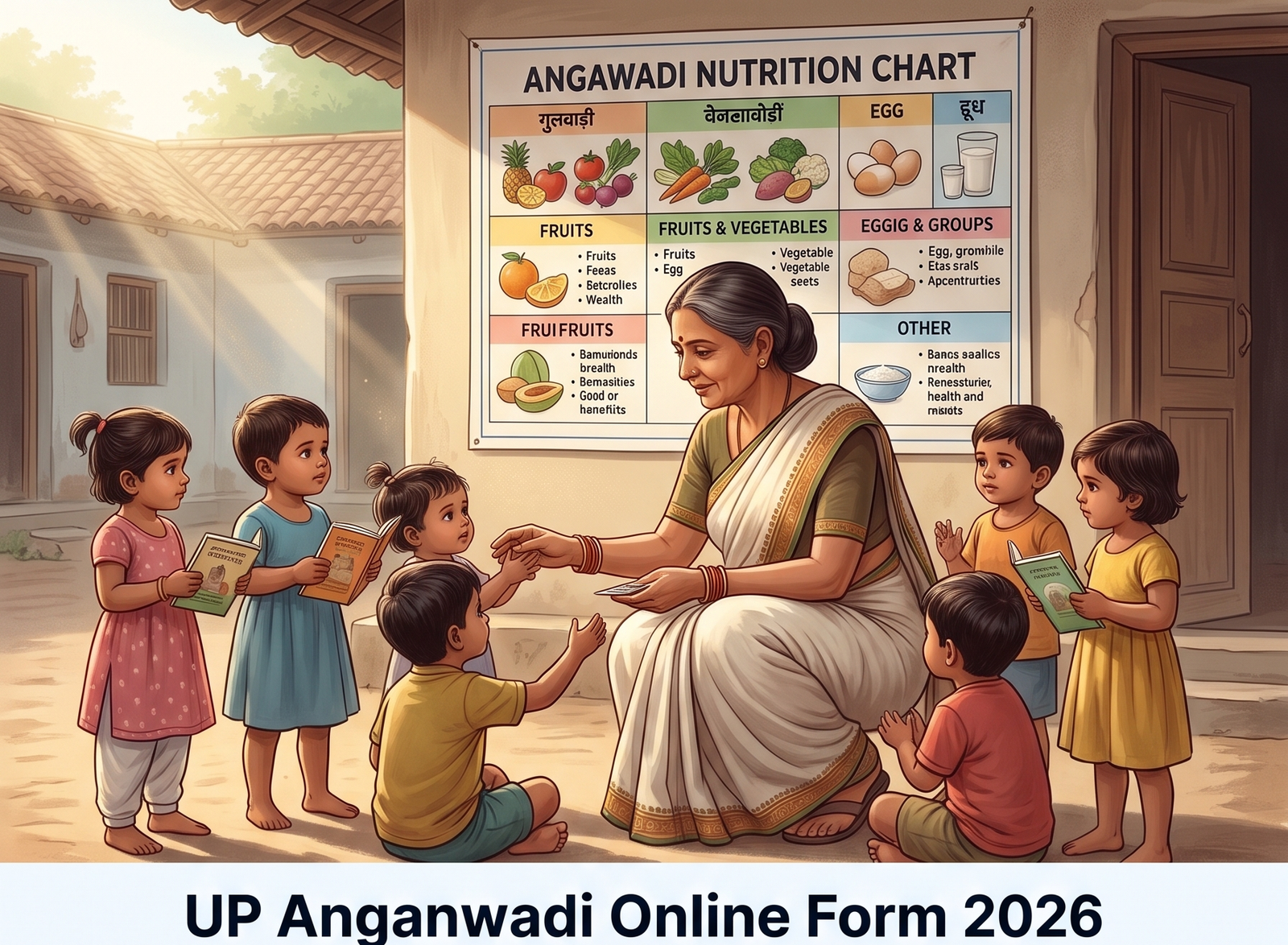
Anganwadi centres are the backbone of India’s rural and semi-urban child healthcare and nutrition system. Each centre needs two key roles:
- Anganwadi Worker (Karyakartri) — manages the centre, handles nutrition distribution, pre-school education, and health tracking of children and mothers.
- Anganwadi Helper (Sahayika) — assists the worker with daily operations, cooking, cleaning, and outreach.
Every year, vacancies open up across UP as workers retire, transfer, or new centres get sanctioned. The District Programme Officer (DPO) of each district issues a separate notification, and applications are collected through the official portal, upanganwadibharti.in.
As of mid-2026, notifications are active for districts including Shravasti, Chandauli, Moradabad, Varanasi, Bhadohi, Bagpat, and Kannauj, with more districts expected to follow through the second half of the year.
Why This Recruitment Matters
For many women in rural UP, this isn’t just “a job” — it’s often the first formal income opportunity available close to home. A few reasons this recruitment is worth serious attention:
- No application fee — the process is completely free, which removes a major barrier for low-income applicants.
- Local postings — you’re generally placed within your own gram sabha, ward, or nyaya panchayat, so relocation isn’t required.
- Merit-based, transparent selection — no written exam means less exam-prep pressure, but it also means your documents and marks matter more.
- Social impact role — you’re directly contributing to child nutrition, immunization tracking, and early education in your community.
Eligibility Criteria
Before you start filling the form, check these boxes carefully. Requirements are broadly uniform across districts, though some vacancies (like Helper posts) may have slightly relaxed education norms.
Gender and Residency
- Only female candidates are eligible to apply.
- You must be a permanent resident of the gram sabha, ward, or nyaya panchayat where the vacancy exists. If no eligible candidate is available locally, the vacancy opens to residents of the broader nyaya panchayat.
Educational Qualification
- Minimum qualification: 10+2 (Intermediate) from a recognised board in India.
- Some Helper posts may accept Class 8 or 10 pass, depending on district-specific rules — always confirm against your district’s official PDF notification.
Age Limit
- Minimum age: 18 years
- Maximum age: 35 years
- Age is calculated as on 1 July of the recruitment year (check your specific district notification for the exact cut-off date, since this can shift slightly year to year).
- Age relaxation is available for reserved categories (SC/ST/OBC/EWS) as per standard UP government rules.
Additional Preference Criteria
Many districts give preference points for:
- Being a widow, divorcee, or destitute woman
- Having a smaller family (as per the two-child norm in some districts)
- Prior experience as an Anganwadi Helper (when applying for Worker posts)
- BPL (Below Poverty Line) family status
Important Dates 2026
Because this recruitment is district-wise, there is no single national deadline. Here’s how it’s actually working on the ground, with a few live examples as of July 2026:
| District | Notification Status | Last Date to Apply |
|---|---|---|
| Shravasti | Active | 27 July 2026 |
| Chandauli | Active | 25 July 2026 |
| Moradabad | Active | 23 July 2026 |
| Varanasi | Active | 31 July 2026 |
| Bagpat & Kannauj | Active | 16 July 2026 |
Note: These dates were accurate at the time of writing but districts frequently extend or update deadlines. Always cross-check the live status on the official portal before applying.
Practical tip: Bookmark upanganwadibharti.in and check it weekly if your district hasn’t opened applications yet — new district notifications are being added on a rolling basis through 2026.
Documents Required
Keep scanned copies (JPEG/PDF, usually under 200 KB each) ready before you start:
- Aadhaar Card
- High School and Intermediate mark sheets/certificates
- Domicile/residence proof (ration card, voter ID, or gram panchayat certificate)
- Caste certificate (if applying under reserved category)
- Income certificate (if claiming BPL/EWS benefit)
- Passport-size photograph (recent, white background)
- Signature (scanned)
- Mobile number linked to Aadhaar (for OTP verification)
- Widow/divorce certificate (if applicable, for preference points)
Step-by-Step Application Guide
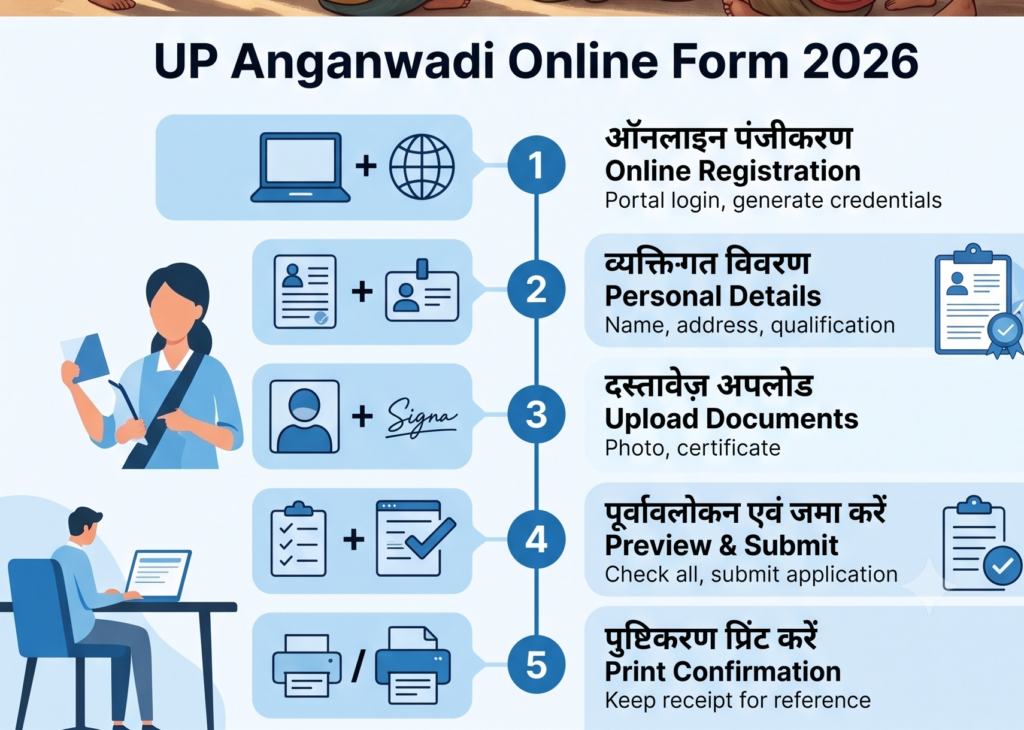
- Visit the official portal — go to upanganwadibharti.in. Avoid third-party sites claiming to be “official”; several look-alike sites exist.
- Check your district’s notification — click on your district name and confirm the post (Worker or Helper), vacancy count, and last date.
- Click “New Registration” — enter your name, date of birth, mobile number, and Aadhaar number to create your login.
- Set a password — you’ll use your registered mobile number and password to log back in later, so save these somewhere safe.
- Log in and fill the application form — enter personal, educational, and address details exactly as they appear on your certificates.
- Upload documents — follow the exact size and format instructions given on the portal; mismatched formats are a common rejection reason.
- Review before submitting — double-check your date of birth, category, and district selection since these usually cannot be edited after submission.
- Submit and print — download and print the confirmation page/acknowledgment for your records.
Only document verification requires you to visit the district office in person — the rest of the process is fully online.
Selection Process
Selection for Anganwadi posts in UP does not involve a written exam. Instead, it follows a merit list system based on:
- Educational qualification (higher qualification generally scores higher, within eligible categories)
- Category-based reservation rules
- Preference criteria (widow, destitute, BPL status, etc.)
- Local residency verification
Once the merit list is published (usually on the district’s official notice board and the portal), shortlisted candidates are called for document verification. Final selection happens after this verification is cleared.
Tips and Best Practices
- Apply early within the window — servers often slow down in the last 2–3 days before deadlines.
- Match your name spelling across Aadhaar, mark sheets, and the form — even minor mismatches can cause verification issues later.
- Keep your mobile number active — all OTPs, verification calls, and merit list alerts go through this number.
- Save your registration ID and password immediately after signup; there’s no easy recovery process if lost.
- Read the district PDF notification fully, not just summary articles like this one — reservation percentages and preference weightage vary by district.
Common Mistakes to Avoid
- Applying from the wrong gram sabha/ward — this is the single biggest reason for rejection, since residency is strictly checked.
- Uploading blurry or oversized documents — leads to automatic form rejection during verification.
- Confusing Worker and Helper eligibility — the two posts have different minimum qualifications; don’t assume they’re the same.
- Missing the district-specific deadline because you tracked a neighboring district’s date instead.
- Ignoring the official notification PDF and relying only on unofficial job portals for exact eligibility numbers.
Latest Updates and Trends
- Applications for 2026 began rolling out district-wise starting November 2025, and fresh district notifications are still being issued through mid-2026 — some districts have announced 60,000+ combined vacancies across the state over this cycle.
- More districts are shifting toward fully paperless verification, reducing the need for physical office visits except for final document checks.
- There’s a growing trend of districts publishing notifications in both Hindi and English on the portal, making it easier for candidates to understand eligibility without relying on third-party sites.
- Some districts have started explicitly listing preference weightage tables in their PDFs (for widow/BPL/destitute categories), which is more transparent than in earlier recruitment cycles.
Key Takeaways
- UP Anganwadi Recruitment 2026 is district-wise, free of cost, and open only to female candidates aged 18–35.
- Minimum qualification is generally 10+2, though Helper posts may accept lower qualifications in some districts.
- Selection is merit-based, not exam-based — your documents and category status matter most.
- Always apply through the official portal (upanganwadibharti.in) and verify your specific district’s deadline directly.
- Residency in the gram sabha/ward/nyaya panchayat of the vacancy is a non-negotiable requirement.
Conclusion
The UP Anganwadi Online Form 2026 is a genuine, low-barrier opportunity for women across Uttar Pradesh to step into meaningful, community-based government work. The process is free, fully online (except final verification), and doesn’t require clearing a competitive exam — but it does reward candidates who prepare their documents carefully and apply within their correct district window. If you’re eligible, don’t wait for the last few days to apply. Check your district’s status on the official portal today, gather your documents, and get your application in early.
FAQs
1. What is the official website for UP Anganwadi Online Form 2026? The official portal is upanganwadibharti.in, run by the district-level Bal Vikas Seva Evam Pushtahar Vibhag offices.
2. Is there an application fee for UP Anganwadi Bharti 2026? No. The entire application process is free of cost for all categories.
3. Can married women apply for UP Anganwadi Worker/Helper posts? Yes, marital status alone doesn’t disqualify a candidate, though widows and destitute women often receive preference points.
4. What is the age limit for UP Anganwadi Recruitment 2026? Candidates must be between 18 and 35 years of age, generally calculated as on 1 July of the recruitment year, with relaxation for reserved categories.
5. Is there a written exam for UP Anganwadi posts? No. Selection is entirely merit-list based, using educational qualification, category, and preference criteria — there is no written test or interview in most districts.
6. Can I apply for a district other than where I live? Generally no. You must be a permanent resident of the specific gram sabha, ward, or nyaya panchayat associated with the vacancy.
7. How will I know if my UP Anganwadi form for 2026 is accepted? After submission, you’ll get a confirmation/acknowledgment page to print. Merit lists and verification calls are later published on the same portal and district notice boards.