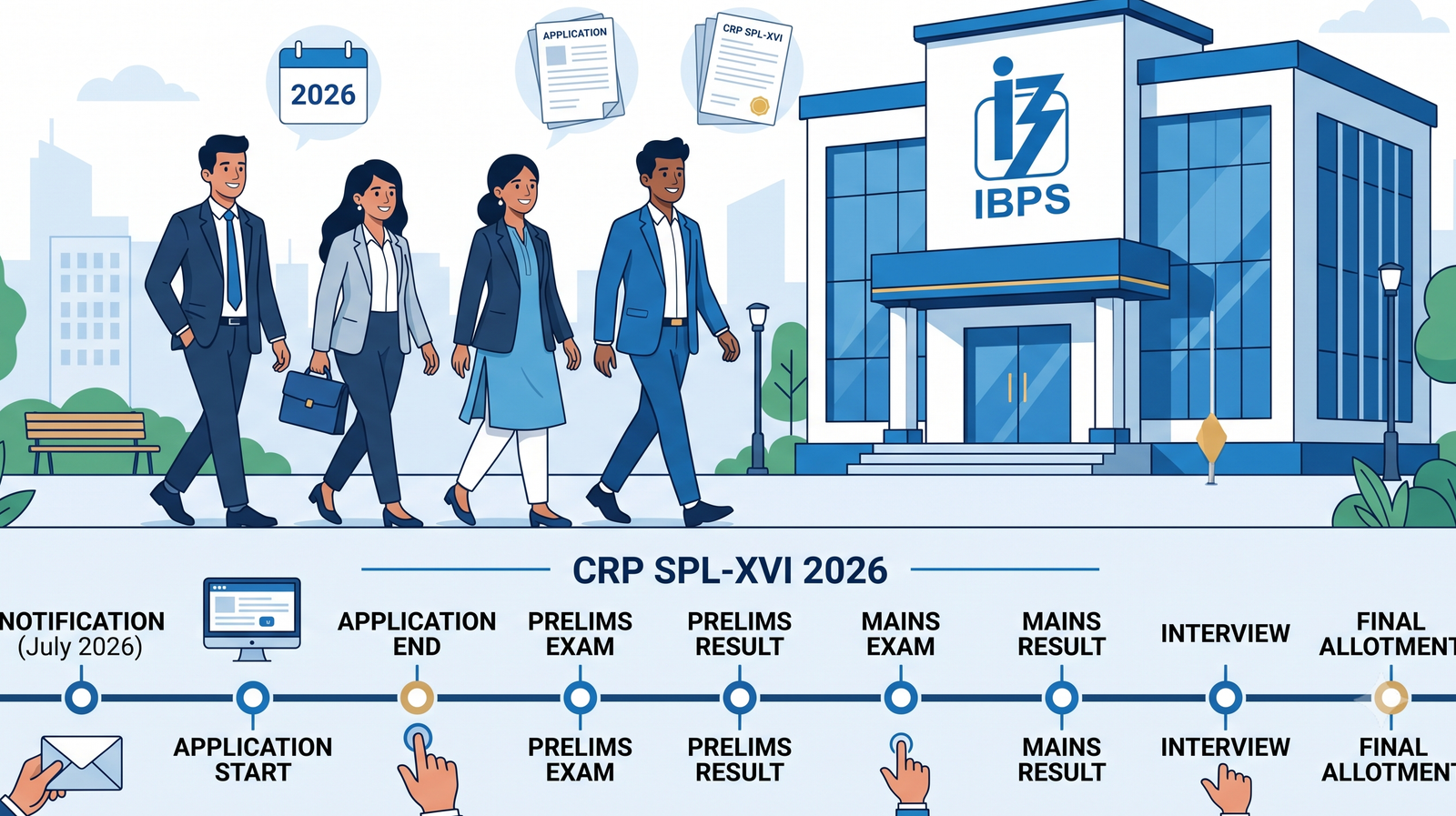
If you’ve been refreshing the IBPS website every morning waiting for this year’s Specialist Officer notification, the wait is over. The Institute of Banking Personnel Selection released the IBPS SO XVI (CRP SPL-XVI) notification on 30th June 2026, and the online application window opened right after. Whether you’re an engineering graduate eyeing the IT Officer post, a law graduate targeting Law Officer, or an agriculture graduate aiming for Agricultural Field Officer, this guide walks you through everything — important dates, eligibility, application steps, exam pattern, and a realistic preparation roadmap — so you don’t miss a single deadline or requirement.
Table of Contents
- What is IBPS SO XVI 2026?
- Important Dates You Cannot Miss
- Vacancy Details (Post-Wise)
- Eligibility Criteria
- Application Fee & How to Apply
- Documents Required
- Exam Pattern (Prelims & Mains)
- Selection Process & Salary
- Step-by-Step Preparation Strategy
- Common Mistakes Candidates Make
- Latest Updates & Trends for 2026
- Key Takeaways
- Conclusion
- FAQs
1. What is IBPS SO XVI 2026?
IBPS SO stands for Institute of Banking Personnel Selection – Specialist Officer. Unlike IBPS PO or Clerk, this exam recruits domain specialists — not generalist bankers — for roles like IT Officer, Law Officer, HR/Personnel Officer, Marketing Officer, Agricultural Field Officer (AFO), and Rajbhasha Adhikari.
This year’s cycle is officially the 16th edition, so it’s called CRP SPL-XVI. <cite index=”1-1″>Selected candidates join public sector banks as Scale I officers in their area of specialization</cite>. If you hold a professional degree — MBA, B.Tech/IT, Agriculture, LLB, or a PG in Hindi/English — this is one of the most direct routes into a banking career without competing against generalist candidates.
2. Important Dates You Cannot Miss
| Event | Date |
|---|---|
| Notification Released | 30th June 2026 |
| Online Application Starts | 1st July 2026 |
| Last Date to Apply Online | 21st July 2026 |
| Last Date for Fee Payment | 21st July 2026 |
| Prelims Exam | 29th August 2026 |
| Mains Exam | 1st November 2026 |
<cite index=”8-1″>The online application process opened on 1st July for posts including IT Officer, AFO, Law Officer, HR/Personnel Officer, Marketing Officer, and Rajbhasha Adhikari</cite>. That’s a tight three-week window, so don’t leave your registration for the last two days — server load spikes badly in the final 48 hours every year.
Pro tip: Set a calendar reminder for 15th July, giving yourself a six-day buffer before the deadline in case of document upload issues or payment gateway failures.
3. Vacancy Details (Post-Wise)
<cite index=”8-1″>This year’s notification covers 745 Specialist Officer vacancies across participating Public Sector Banks</cite>. Here’s the post-wise breakup:
- IT Officer Scale I: <cite index=”17-1″>301 vacancies</cite> — the single largest chunk this year
- Agricultural Field Officer (AFO): <cite index=”12-1″>190 vacancies</cite>
- Law Officer: <cite index=”12-1″>105 vacancies</cite>
- HR/Personnel Officer, Marketing Officer, Rajbhasha Adhikari: remaining vacancies distributed across these posts
<cite index=”8-1″>Participating banks include Bank of Baroda, Bank of India, Bank of Maharashtra, Canara Bank, Central Bank of India, Indian Bank, Indian Overseas Bank, Punjab National Bank, Punjab & Sind Bank, UCO Bank, and Union Bank of India</cite>. Since IT Officer has the highest vacancy count, competition-to-seat ratio is comparatively more favorable there this year — worth factoring into your post preference order.
4. Eligibility Criteria
Nationality
You must be an Indian citizen, or fall under specified categories such as a subject of Nepal, a Tibetan refugee settled in India before 1st January 1962, or a person of Indian origin who migrated from countries like Pakistan, Myanmar, Sri Lanka, or East African nations, subject to eligibility certification.
Age Limit
<cite index=”2-1″>The general age limit is 20 to 30 years</cite>, calculated as on the cut-off date mentioned in the notification. Age relaxation applies for reserved categories:
- SC/ST: 5 years
- OBC: 3 years
- PwBD: 10 years
- Additional relaxation for ex-servicemen as per government norms
Educational Qualification
This is where posts differ significantly:
- IT Officer: Engineering degree in Computer Science/IT, or MCA, or equivalent
- Law Officer: A Bachelor’s degree in Law (LLB) with enrollment as an advocate
- Agricultural Field Officer: Bachelor’s degree in Agriculture or allied fields (Horticulture, Animal Husbandry, Dairy Science, etc.)
- HR/Personnel Officer: Graduate + full-time Postgraduate degree/diploma in HR, Personnel Management, or Industrial Relations
- Marketing Officer: Graduate + MBA/PG diploma in Marketing
- Rajbhasha Adhikari: Postgraduate degree in Hindi with English as a subject at degree level, or vice versa
One important note: <cite index=”12-1″>candidates must have completed their required educational qualification before the application deadline</cite> — final-year students who haven’t received their degree yet are not eligible to apply this cycle.
5. Application Fee & How to Apply
<cite index=”11-1″>The application fee is Rs. 850 for General and OBC candidates, reduced to Rs. 175 for SC/ST/PwBD candidates</cite>. Fee is payable online only, and once paid, it is non-refundable — so double-check your post preference and category selection before submitting payment.
Step-by-Step Application Process
- Visit the official website www.ibps.in
- Click on “CRP-Specialist Officers” under the Career section, then select “New Registration”
- Enter basic details — name, mobile number, email ID, and address — and save
- <cite index=”11-1″>Upload your photograph and signature in the prescribed format and size</cite>
- <cite index=”11-1″>Select your preferred post(s) — IT Officer, Law Officer, AFO, HR, Marketing, or Rajbhasha — and fill in educational qualification details</cite>
- Pay the application fee via Credit Card, Debit Card, or Net Banking
- <cite index=”11-1″>Recheck the application preview carefully for errors before final submission</cite>
- Download and print the confirmation page for future reference
Real-world tip: Keep scanned copies of your photograph, signature, and category certificate ready in the exact size and format specified before you start the form. Most candidates lose 15–20 minutes mid-application scrambling to resize an image — do this prep the night before.
6. Documents Required
- Passport-size photograph (recent, prescribed dimensions)
- Signature scan
- Left thumb impression
- Handwritten declaration in the prescribed format
- Valid photo ID proof
- Category certificate (if applicable)
- Educational certificates and mark sheets
7. Exam Pattern (Prelims & Mains)
The IBPS SO exam pattern has been revised for 2026, with Professional Knowledge now carrying more weight even at the Prelims stage for several posts.
Prelims (Qualifying in Nature)
For IT Officer, AFO, HR/Personnel Officer, and Marketing Officer, the Prelims typically tests:
- Reasoning
- English Language
- Quantitative Aptitude
- Professional Knowledge (added weight in the revised pattern)
For Law Officer and Rajbhasha Adhikari, the pattern differs slightly, with a stronger focus on Professional Knowledge relative to general sections.
<cite index=”1-1″>There is a negative marking of 0.25 marks for every wrong answer</cite> in both Prelims and Mains objective tests, so accuracy matters more than attempting every question.
Mains Exam
The Mains is the real gatekeeper. <cite index=”12-1″>The exam pattern is different for Law Officer, IT Officer, Agriculture Field Officer, HR/Personnel Officer, Marketing Officer, and Rajbhasha Adhikari posts</cite>, and it’s heavily weighted toward Professional Knowledge specific to your chosen post, often combined with a descriptive test (essay/letter writing).
Important: Prelims marks are not carried forward. Only your Mains and Interview scores decide your final merit position — so don’t over-invest prep time in Prelims at the cost of Professional Knowledge depth.
8. Selection Process & Salary
The selection process has three stages:
- Preliminary Exam — qualifying only
- Main Exam — Professional Knowledge + descriptive paper
- Interview — final round before provisional allotment
Final merit is typically calculated with Mains and Interview marks combined in an 80:20 weightage.
<cite index=”1-1″>The starting basic pay for IBPS SO is around Rs. 48,480</cite>, <cite index=”12-1″>structured as Rs. 48,480–2,000/7–62,480–2,340/2–67,160–2,680/7–85,920</cite>. Along with basic pay, officers receive Dearness Allowance, House Rent Allowance, Special Allowance, medical benefits, and pension under the National Pension System — pushing gross monthly salary well above the basic figure once allowances are added, depending on the posting location.
9. Step-by-Step Preparation Strategy
Here’s a realistic 8-week roadmap based on the current exam calendar (Prelims on 29th August):
Weeks 1–3: Build the Foundation
- Start Professional Knowledge from day one — it’s now weighted heavily even in Prelims
- IT Officer aspirants: prioritize DBMS, Computer Networks (OSI/TCP-IP), Operating Systems, and Data Structures
- Law Officer aspirants: focus on Banking Law, Constitutional basics, and Negotiable Instruments Act
- AFO aspirants: cover Agronomy, Soil Science, and government agricultural schemes
- Parallel: 30 minutes daily on Quant fundamentals (arithmetic, DI)
Weeks 4–5: Layer in General Sections
- Add Reasoning puzzles (2 sets/day) and English Reading Comprehension
- Continue advancing Professional Knowledge — cover the remaining syllabus areas for your post
- Take your first sectional mock tests, targeting 70%+ accuracy before moving to full mocks
Weeks 6–7: Full Mock Mode
- Switch to complete Prelims mock simulations under real time constraints
- Analyze section-wise cutoffs from previous attempts, not just overall scores
- Ruthlessly fix your two weakest areas — don’t spread revision thin
Week 8 Onward (Post-Prelims): Mains Focus
- Deep-dive into post-specific Professional Knowledge for Mains
- Practice descriptive writing daily — one essay and one letter/report
- Solve previous years’ Mains papers to understand question depth and expected answer length
10. Common Mistakes Candidates Make
- Ignoring Professional Knowledge until after Prelims: With PK now carrying real weight in Prelims for several posts, this is the costliest mistake this cycle.
- Treating Prelims as the real exam: Since Prelims marks don’t count toward final merit, over-preparing there while neglecting Mains-level depth backfires.
- Applying for multiple posts without matching qualification: Each post has a distinct educational qualification. Double-check yours against the notification before selecting a post — mismatched applications get rejected at the verification stage, not before.
- Skipping the descriptive test practice: Many technically strong candidates lose Mains marks purely on weak essay/letter writing under time pressure.
- Last-minute document uploads: Format and size errors during the final submission window are entirely avoidable with advance preparation.
11. Latest Updates & Trends for 2026
- The Prelims and Mains exam pattern has been revised for this cycle, with Professional Knowledge given greater weightage — a shift from earlier years where PK appeared mainly at the Mains stage.
- <cite index=”6-1″>IBPS has introduced enhanced verification measures including Aadhaar-based authentication and live photo capture during the application process</cite> for improved transparency — expect this across the SO application as well, so keep your Aadhaar details consistent with other official documents.
- IT Officer continues to be the post with the highest vacancy share, reflecting sustained demand for tech talent within public sector banks as they scale up digital banking infrastructure.
- Competition for IBPS SO remains comparatively lower than IBPS PO in terms of applicant volume, which can translate to better odds for well-prepared specialist candidates.
Key Takeaways
- IBPS SO XVI 2026 online applications run from 1st to 21st July 2026 — don’t wait till the last day.
- 745 vacancies are on offer, with IT Officer leading at 301 posts.
- Age limit is 20–30 years; educational qualification is strictly post-specific.
- Application fee: Rs. 850 (General/OBC), Rs. 175 (SC/ST/PwBD).
- Prelims is on 29th August 2026 and is qualifying only — Mains and Interview decide your final rank.
- Start Professional Knowledge preparation immediately; it now carries significant weight even at Prelims.
Conclusion
The IBPS SO XVI 2026 cycle rewards candidates who treat Professional Knowledge as their primary battleground rather than an afterthought. With the application window open until 21st July and Prelims just weeks away on 29th August, the smartest move right now is to lock in your post choice based on your actual qualification, complete your application early, and start building domain depth today rather than after Prelims. Bookmark the official IBPS website for updates, and use the roadmap above as your working plan — adjust the pace, not the priorities.
FAQs
Q1. What is the last date to apply for IBPS SO XVI 2026? The online application window closes on 21st July 2026, along with the last date for fee payment.
Q2. How many vacancies are there in IBPS SO 2026? A total of 745 Specialist Officer vacancies have been announced, with IT Officer having the highest share at 301 posts.
Q3. What is the age limit for IBPS SO 2026? Candidates must be between 20 and 30 years of age as on the cut-off date, with standard age relaxations for reserved categories.
Q4. Is there negative marking in IBPS SO exam? Yes, 0.25 marks are deducted for every wrong answer in both the Prelims and Mains objective papers.
Q5. Do Prelims marks count in the final IBPS SO merit list? No. Prelims is qualifying in nature only. Final selection is based on combined Mains and Interview scores.
Q6. What is the application fee for IBPS SO 2026? Rs. 850 for General and OBC candidates, and Rs. 175 for SC/ST/PwBD candidates.
Q7. Can final-year students apply for IBPS SO 2026? No. Candidates must have already completed their required educational qualification by the application deadline.