Supreme Court Law Clerk Recruitment 2026 – Online Form, Exam Date & Details
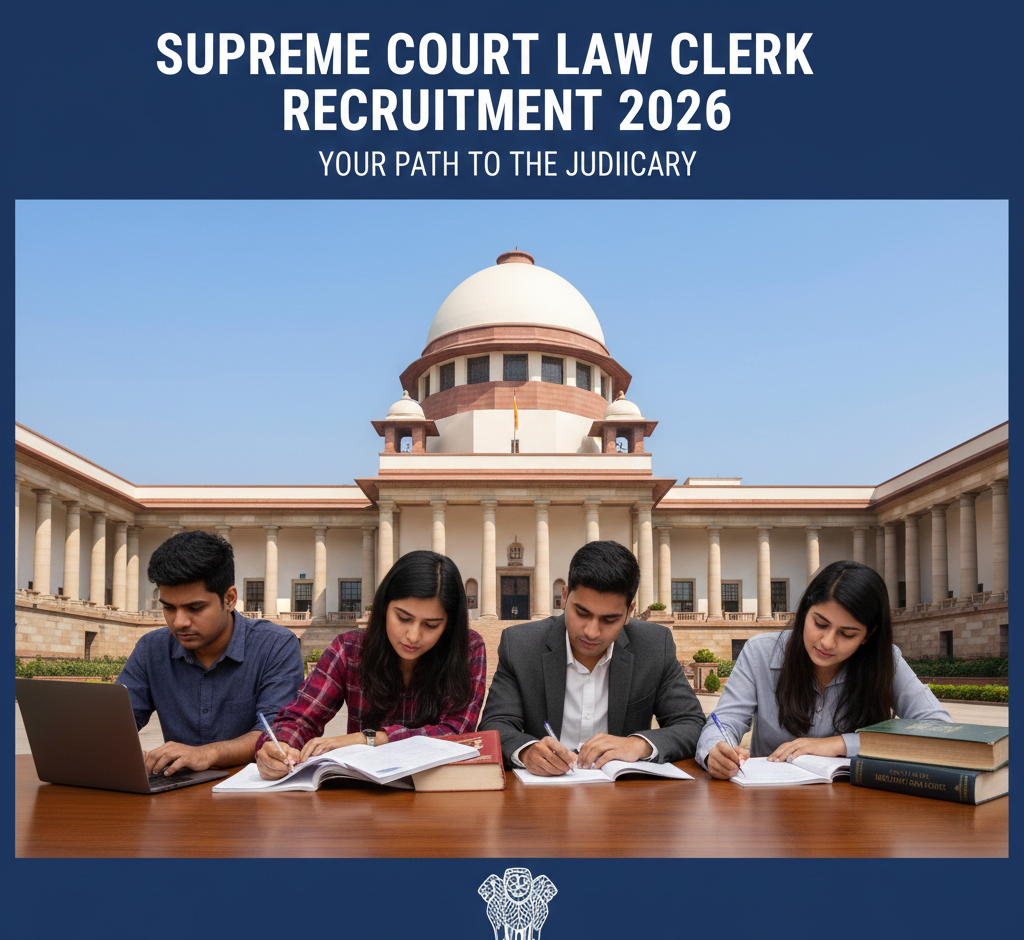
The Supreme Court of India has invited online applications for the post of Law Clerk-cum-Research Associate for the 2026–27 term. This recruitment is for short-term contractual engagement, where selected candidates will work with Hon’ble Judges of the Supreme Court on legal research, case analysis, drafting assistance and other judicial tasks.
This is a prestigious opportunity for law graduates and final-year students to work under the guidance of Hon’ble Judges of the Supreme Court.
📅 Important Dates – Law Clerk 2026
| Event | Date |
|---|---|
| Online Application Start | 20 January 2026 |
| Last Date to Apply Online | 07 February 2026 |
| Written Test (Part I & Part II) | 07 March 2026 |
| Admit Card / Call Letter | Before Exam (TBA) |
| Answer Key Release | 08 March 2026 then objections period |
👉 Online applications are accepted only through the Supreme Court official recruitment portal.
📌 Vacancy & Remuneration
✔️ Post: Law Clerk-cum-Research Associate
✔️ Approx. Vacancies: ~90 candidates (panel)
✔️ Remuneration: Consolidated ₹80,000 per month for the contractual term.
✔️ Nature: Short-term contractual assignment (not permanent employment).
🎓 Eligibility Criteria
- Educational Qualification: * Must be a Law Graduate (Bachelor’s Degree in Law) from a BCI-recognized institution.
- Final Year Students: Candidates in the 5th year of a 5-year integrated course or the 3rd year of a 3-year LLB course are eligible to apply, provided they furnish proof of graduation before joining.
- Age Limit (as of Feb 7, 2026): * Minimum: 20 Years
- Maximum: 32 Years
- Additional Skills: Proficiency in legal research using databases like e-SCR, Manupatra, SCC Online, LexisNexis, and Westlaw is essential.
📝 Exam Pattern & Selection Process
The selection process is rigorous and divided into three distinct phases:
- Phase I: Multiple Choice Test (100 Marks)
- Tests English comprehension, analytical aptitude, and legal knowledge.
- Marking: $+1$ for correct; $-0.25$ for incorrect.
- Cut-off: Minimum 40% marks required to qualify for Phase II.
- Phase II: Subjective Written Exam (300 Marks)
- Includes Case Briefing (summarizing facts/issues), Drafting Research Memorandums, and an Analytical Essay on contemporary legal issues.
- Phase III: Personal Interview (100 Marks)
- Conducted by a Committee of Hon’ble Judges to assess legal acumen and maturity.
💰 Salary & Tenure
- Remuneration: ₹1,00,000 per month (Consolidated).
- Tenure: Initially for the assignment term (usually one year), extendable based on performance and the Judge’s requirement
📥 How to Apply Online
- Visit the Supreme Court official recruitment portal (on sci.gov.in recruitment section).
- Click the link for Law Clerk-cum-Research Associate 2026.
- Register with email & mobile number.
- Fill the online application form with personal and academic details.
- Upload scanned photo and signature.
- Pay the application fee (₹750 + charges) online.
- Submit the form and save / print confirmation for future reference.
📌 Applications not following instructions or after the deadline will be rejected automatically
📌 Application Fee
✔️ All candidates: ₹750 + applicable bank charges (non-refundable).
✔️ Paid online only during form submission.
📝 Important Tips
✔️ Verify your law degrees / documents before applying.
✔️ Keep your login credentials (Registration email / password) safe.
✔️ Admit cards for Part I & II will be issued online before the exam date.
🧠 Summary
| Detail | Information |
|---|---|
| Exam Name | Supreme Court Law Clerk 2026 |
| Apply Start | 20 January 2026 |
| Last Date | 07 February 2026 |
| Written Exam | 07 March 2026 |
| Selection Stages | Part I (MCQ) → Part II (Subjective) → Interview |
| Age Limit | 20–32 years |
| Application Fee | ₹750+charges |
| Official Website | sci.gov.in (Recruitments) |
Preparation for the Supreme Court Law Clerk (Part II) 2026 requires a shift from objective recall to professional legal drafting. Since the exam date is typically in March or April, focusing on these subjective components now is critical.
📝 Part II: Subjective Exam Breakdown (300 Marks)
This section is 3.5 hours long (including 30 minutes of reading time). You must score at least 50% to qualify for the interview.
| Component | Marks | Word Limit | Objective |
| Case Briefing (Synopsis) | 100-150 | 750 words | Summarize an SLP, Civil/Criminal Appeal, or Writ Petition. |
| Draft Research Memo | 75 | 500-750 words | Resolve a factual dispute using provided statutes and precedents. |
| Analytical Essay | 75 | 350-500 words | Argue one out of five topics on contemporary legal/policy issues. |
📖 Syllabus & Strategy for Subjective Questions
1. Case Briefing (The “Synopsis”)
You will be given a bulky case file. Your job is to extract the “meat” of the case.
- Structure: Introduction (Parties) → Material Facts → Procedural History (Lower Court rulings) → Core Legal Issues → Ratio Decidendi (Reasoning of the High Court) → Grounds for Appeal in the Supreme Court.
- Tip: Avoid “legalese” or flowery language. Judges look for clarity and conciseness.
2. Draft Research Memo
This tests your ability to act as a Law Clerk. You are given a fact scenario and a mix of relevant and irrelevant precedents.
- Structure: Issue → Applicable Law (Statutes/Precedents) → Application of Law to Facts → Conclusion/Recommendation.
- Tip: Learn to distinguish a case on its facts. Explain why certain precedents provided in the question paper are not applicable.
3. Analytical Essay
Focus on topics that bridge Law and Society.
- Expected 2026 Topics: Digital Privacy (AI/Data protection), Gender Neutrality in Laws, Federalism (State vs. Centre powers), and Climate Justice.
- Tip: Use the IRAC (Issue, Rule, Analysis, Conclusion) or Thesis-Antithesis-Synthesis model for your arguments.
⚖️ 5 Landmark Judgments of 2025 to Study
For the “Recent Developments” section in Part I and as examples for Part II, master these 2025 rulings:
- Gayatri Balasamy v. ISG Novasoft: A 5-judge bench clarified the limited power of courts to modify arbitral awards under Section 34.
- Padi Kaushik Reddy v. State of Telangana: Established that the Speaker’s delay in deciding disqualification petitions under the 10th Schedule is subject to judicial review.
- Waqf (Amendment) Act Interim Ruling: The SC upheld mandatory registration and ownership requirements while placing guardrails on monument declarations.
- District Judge Recruitment Case (Art. 233): Ruled that judicial officers with 7 years of prior Bar experience are eligible for direct recruitment as District Judges.
- Ex Post Facto Environmental Clearance Case: A split 2:1 verdict held that ex post facto clearances are not inherently illegal but should be granted sparingly.
💻 Technical Skill Check
Ensure you are comfortable using these databases, as they are often referenced in the exam:
- e-SCR: The Supreme Court’s official free search engine.
- SCC Online / Manupatra: For tracking the “Check Citations” or “Case History” feature.