Table of Contents
- What Is IIT JEE Advanced 2026?
- Important Dates & Schedule
- Eligibility Criteria
- Exam Pattern & Paper Structure
- Syllabus Highlights
- How to Prepare: Step-by-Step Guide
- Best Books & Resources
- Common Mistakes to Avoid
- Tips from IIT Toppers
- Key Takeaways
- FAQs
Introduction
Every year, over 1.5 lakh students sit for IIT JEE Advanced — and fewer than 17,000 make it through. That number tells you everything about how competitive this exam really is.
If you are targeting IIT JEE Advanced 2026, you already know the stakes. This is not just an entrance exam. It is the gateway to India’s premier Indian Institutes of Technology (IITs) — and one of the most respected engineering entrance tests in the world.
In this guide, you will find everything you need in one place: confirmed exam dates, eligibility rules, paper pattern, subject-wise syllabus, and a realistic preparation roadmap — all updated for 2026.
Whether you are just starting your preparation or fine-tuning in the final months, this article gives you the full picture.
What Is IIT JEE Advanced 2026?
JEE Advanced is the second stage of the Joint Entrance Examination conducted by one of the seven zonal IITs on a rotational basis. For 2026, IIT Kanpur is the organizing institute.
Only students who clear JEE Main 2026 with a qualifying rank are eligible to appear in JEE Advanced. It tests Physics, Chemistry, and Mathematics at a depth that goes well beyond standard board-level knowledge.
Clearing JEE Advanced is the only route to undergraduate admissions (B.Tech, B.Arch, BS, Dual Degree) at the 23 IITs across India.
Important Dates & Schedule
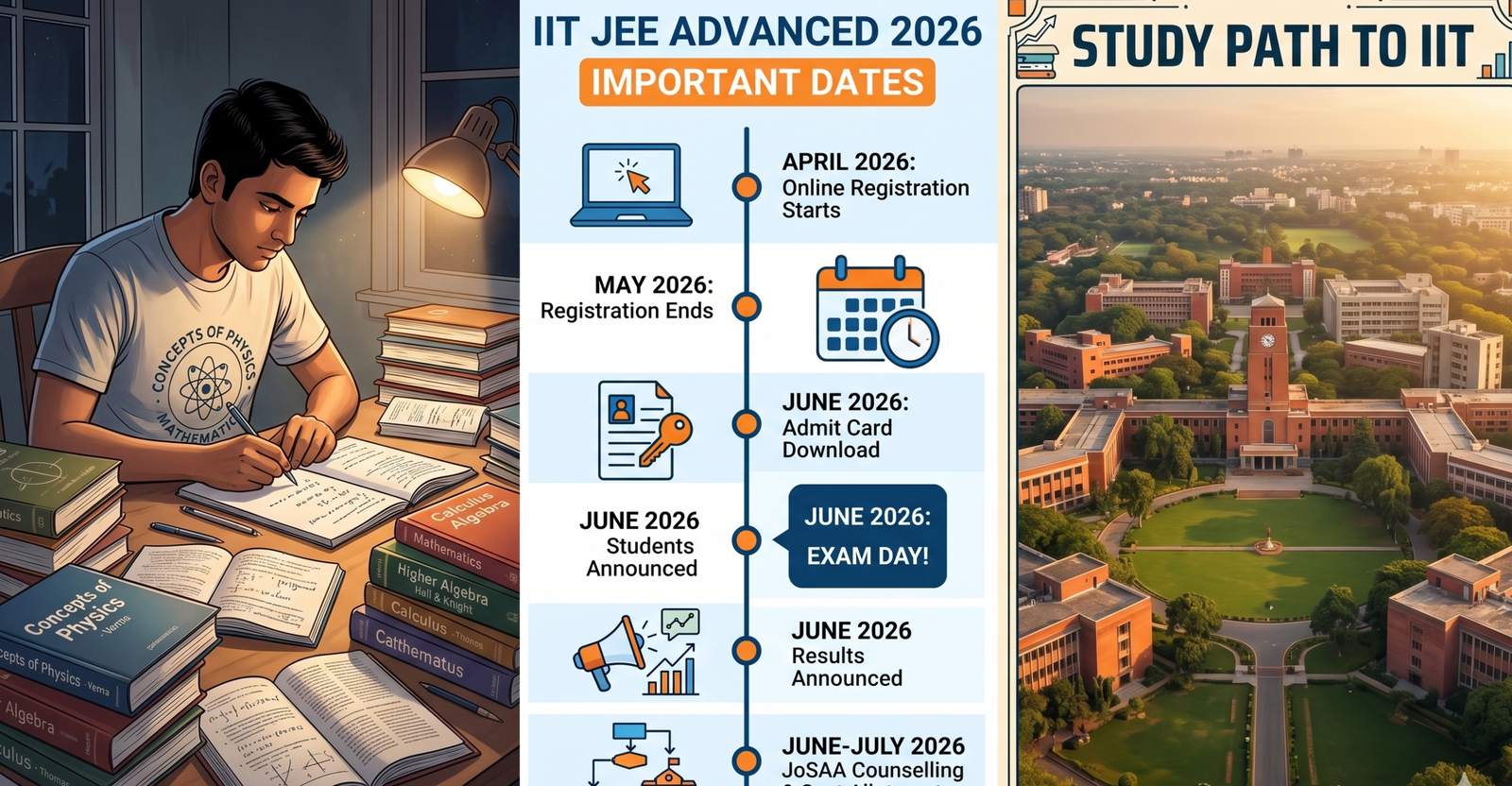
Note: Official dates are released by the organizing IIT. The schedule below reflects the expected calendar based on previous years’ patterns and announcements available as of May 2026. Always verify at the official site: jeeadv.ac.in
| Event | Expected Date |
|---|---|
| JEE Main 2026 Session 1 | January 2026 |
| JEE Main 2026 Session 2 | April 2026 |
| JEE Advanced 2026 Registration Opens | Late April / Early May 2026 |
| Last Date to Register | First week of May 2026 |
| Admit Card Download | Mid-May 2026 |
| JEE Advanced 2026 Exam Date | May 18, 2026 (Expected) |
| Answer Key Release | Within 1 week of exam |
| Result Declaration | June 2026 |
| Architecture Aptitude Test (AAT) | June 2026 |
| Joint Seat Allocation (JoSAA) Counselling | June–July 2026 |
Key symbol to know:
= Critical deadline you must not miss
The registration window is typically open for only 5–7 days. Missing it means waiting another year.
Eligibility Criteria
Understanding the eligibility rules for JEE Advanced 2026 is non-negotiable. Here is a clean breakdown:
1. JEE Main Qualification
- You must be among the top 2.5 lakh candidates (rank-wise) in JEE Main 2026.
- Category-wise cutoffs apply (General, EWS, OBC-NCL, SC, ST, PwD).
2. Age Limit
- You must have been born on or after October 1, 2001 (General/EWS/OBC-NCL).
- SC, ST, and PwD candidates get a 5-year relaxation: born on or after October 1, 1996.
3. Number of Attempts
- A candidate can attempt JEE Advanced a maximum of 2 times in consecutive years.
- If you appeared in JEE Advanced 2025, 2026 is your last attempt.
4. Class 12 Appearance
- You must have appeared for Class 12 (or equivalent) for the first time in 2025 or 2026.
- Candidates who passed Class 12 in 2024 or earlier are not eligible.
5. Earlier Admission at IIT
- If you have previously been admitted to an IIT (even after accepting a seat), you are not eligible — with very limited exceptions.
Exam Pattern & Paper Structure
JEE Advanced 2026 consists of two papers — Paper 1 and Paper 2 — both mandatory.
General Structure
| Feature | Details |
|---|---|
| Mode | Computer-Based Test (CBT) |
| Papers | Paper 1 (Morning) + Paper 2 (Afternoon) |
| Duration | 3 hours each |
| Subjects | Physics, Chemistry, Mathematics |
| Language | English / Hindi |
Question Types (vary by section)
- Single Correct Option (MCQ): One right answer; negative marking applies
- Multiple Correct Options: Partial marking for partially correct answers
- Numerical Answer Type (NAT): Integer or decimal answer; no negative marking
- Match the List / Paragraph-based: Reasoning and comprehension-heavy
Total Marks: Typically 360 marks (180 per paper) — though this may vary slightly in 2026.
Syllabus Highlights
The JEE Advanced syllabus is notoriously deep. Here are the highest-weightage topics across all three subjects:
Physics
- Mechanics (Kinematics, Laws of Motion, Work-Energy)
- Electrostatics & Current Electricity
- Optics (Ray & Wave)
- Modern Physics (Photoelectric effect, Nuclear Physics)
- Thermodynamics
Chemistry
- Physical Chemistry: Equilibrium, Electrochemistry, Thermodynamics
- Organic Chemistry: Reaction Mechanisms, Named Reactions, Biomolecules
- Inorganic Chemistry: Coordination Compounds, p-block Elements
Mathematics
- Calculus (Limits, Differentiation, Integration, Differential Equations)
- Coordinate Geometry
- Vectors & 3D Geometry
- Probability & Statistics
- Complex Numbers & Matrices
Pro tip: JEE Advanced often tests the application of concepts more than rote formulas. Conceptual clarity beats memorization every time.
How to Prepare: Step-by-Step Guide
Step 1: Assess Your Starting Point
Before diving into a schedule, honestly evaluate where you stand in each subject. Take a diagnostic mock test and identify your weak areas.
Step 2: Build a Realistic Timetable
- Aim for 8–10 hours of focused study per day during peak preparation.
- Rotate subjects daily. Never spend more than 3 hours on one subject in a single stretch.
- Reserve 2 hours weekly per subject for revision only.
Step 3: Master NCERT First
NCERT is the foundation — especially for Chemistry. If your NCERT is shaky, advanced problems will feel impossible.
Step 4: Solve Previous Year Papers
Solve at least 10 years of JEE Advanced papers under timed conditions. Papers from 2015 onwards are especially relevant because the exam format shifted to CBT.
Patterns you will notice:
- Physics problems often link two or three concepts together.
- Mathematics rewards elegance — the elegant approach is usually the right one.
- Chemistry has more direct questions but rewards thorough revision.
Step 5: Take Full-Length Mock Tests Weekly
From January 2026 onwards, take at least one full mock test every week. Review every wrong answer immediately after the test — not the next day.
Step 6: Focus on Accuracy, Not Speed (Initially)
Many students rush and lose marks to silly errors. In the early months, prioritize getting the right answer. Speed comes naturally with practice.
Best Books & Resources
Physics
- H.C. Verma — Concepts of Physics (Vol. 1 & 2) — non-negotiable
- D.C. Pandey — Arihant Physics Series
- I.E. Irodov — Problems in General Physics (for advanced practice)
Chemistry
- NCERT Chemistry (Class 11 & 12) — mandatory
- O.P. Tandon — Physical Chemistry
- Morrison & Boyd — Organic Chemistry
- J.D. Lee — Inorganic Chemistry
Mathematics
- R.D. Sharma (for basics)
- S.L. Loney — Trigonometry and Coordinate Geometry
- Hall & Knight — Higher Algebra
- Cengage Mathematics Series
Online Platforms
- Official JEE Advanced website — jeeadv.ac.in
- Khan Academy (concept clarity)
- PW (Physics Wallah), Unacademy, ALLEN Online — for structured courses
Common Mistakes to Avoid
Skipping NCERT — Many students jump to advanced books without NCERT clarity. This backfires in Chemistry particularly.
Not analyzing mock tests — Taking tests without reviewing mistakes is wasted effort. The review session is where actual learning happens.
Ignoring weak subjects — It is tempting to keep practicing what you are already good at. Resist this. A balanced score matters more than perfection in one subject.
Over-relying on coaching notes — Coaching notes summarize; they do not replace understanding. Always go back to the source.
Starting mock tests too late — Many students delay full-length tests until February or March. By then, exam simulation should already be a weekly habit.
Neglecting health — Sleep deprivation kills retention. 7–8 hours of sleep is part of your preparation strategy, not a luxury.
Tips from IIT Toppers
Based on interviews and strategies shared by past JEE Advanced AIR top 100 rankers:
- “Revise more than you study new topics” — Most toppers say the last 3 months were entirely revision-focused.
- “Solve each problem yourself before looking at solutions” — Even if it takes 45 minutes.
- “Build a formula/concept sheet for quick revision” — Maintain a personal notebook, not just printed notes.
- “Treat doubts as urgent” — Unresolved doubts compound. Clear them the same day if possible.
- “The exam rewards calm thinking” — On exam day, read questions twice before attempting. Misreading a question is one of the top reasons for avoidable errors.
Key Takeaways
✅ JEE Advanced 2026 is organized by IIT Kanpur
✅ Only top 2.5 lakh JEE Main qualifiers can register
✅ Maximum 2 attempts allowed in consecutive years
✅ Exam consists of Paper 1 + Paper 2, both mandatory
✅ Registration window is narrow — 5–7 days only
✅ NCERT + standard reference books + previous year papers = the winning formula
✅ Mock tests and honest self-analysis are more valuable than more hours of passive study
Conclusion
IIT JEE Advanced 2026 is tough — but it is not impossible. Thousands of students crack it every year with the right strategy, consistent effort, and the discipline to keep going even when progress feels slow.
Start with clarity on eligibility. Lock in your important dates. Build a structured timetable and stick to it. And most importantly, focus on understanding — not just clearing the exam.
The IITs reward genuine problem-solvers. Become one.
Good luck. Your 2026 chapter starts now.
FAQs
Q1. What is the JEE Advanced 2026 exam date?
JEE Advanced 2026 is expected to be held in May 2026 (tentatively May 18, 2026). The official date will be announced on jeeadv.ac.in. Always check the official site for confirmed schedules.
Q2. Who is the organizing IIT for JEE Advanced 2026?
IIT Kanpur is the organizing institute for JEE Advanced 2026.
Q3. How many attempts are allowed for JEE Advanced?
A candidate can attempt JEE Advanced a maximum of 2 times, in two consecutive years. Missing a year breaks this continuity.
Q4. What is the eligibility cutoff for JEE Advanced 2026?
Candidates must be in the top 2.5 lakh rank holders in JEE Main 2026. Category-wise relaxation applies for SC, ST, OBC-NCL, EWS, and PwD candidates.
Q5. Is NCERT enough for JEE Advanced Chemistry?
NCERT is essential but not sufficient on its own. It should be your starting point and revision base, but you must supplement it with books like O.P. Tandon (Physical), Morrison & Boyd (Organic), and J.D. Lee (Inorganic) for full preparation.
Q6. When does JEE Advanced registration open in 2026?
Registration typically opens in late April or early May, shortly after JEE Main Session 2 results are declared. The window is usually open for 5–7 days only — do not miss it.
Q7. Can I appear in JEE Advanced if I passed Class 12 in 2024?
No. Only students who appeared in Class 12 for the first time in 2025 or 2026 are eligible. Students who passed in 2024 or earlier do not qualify.