If you’re a Class 12 student dreaming of a seat at Delhi University, BHU, JNU, or any of India’s top 250+ universities, there’s one exam you simply cannot ignore — CUET UG 2026.
The Common University Entrance Test (CUET) has transformed undergraduate admissions in India. Gone are the days when a 95%+ board score was the only ticket to a central university. Today, what matters most is how you perform on a single, standardized test. This guide covers everything — from key dates and registration steps to exam pattern, syllabus, and proven preparation strategies.
http://cuet-ug-2026-complete-guide, aiims-norcet-10th-nursing-officer-online-form-2026/
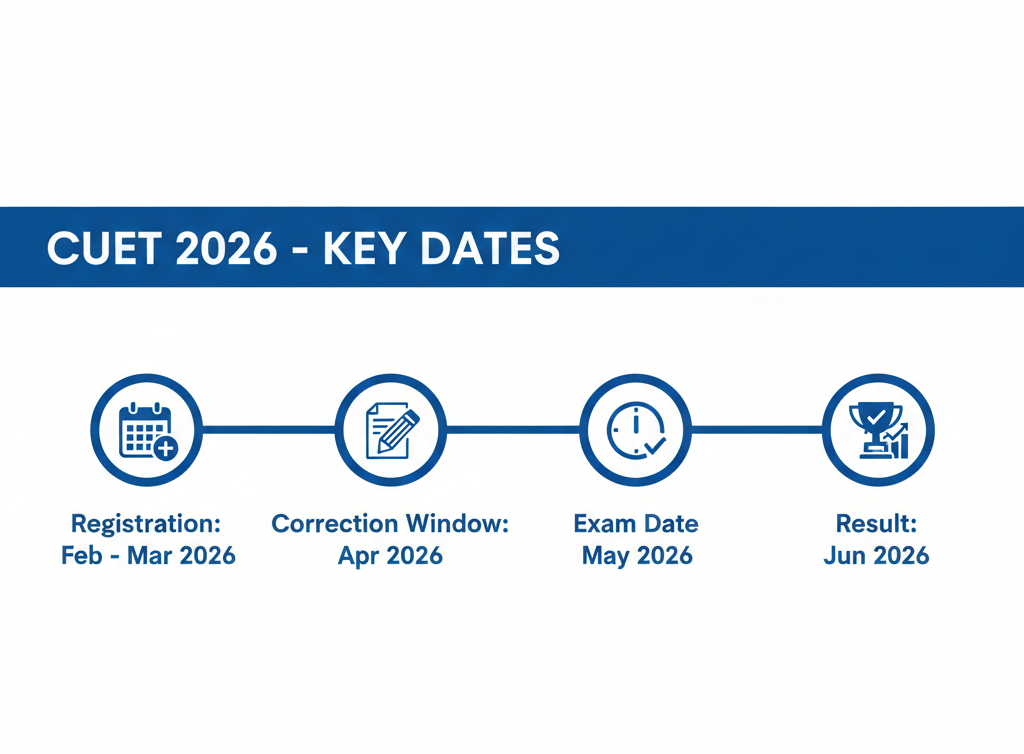
Table of Contents
- What Is CUET UG 2026?
- Key Dates at a Glance
- Eligibility Criteria
- How to Apply — Step-by-Step
- CUET UG 2026 Exam Pattern
- Syllabus Overview
- Application Fee Structure
- Participating Universities
- Preparation Tips That Actually Work
- Common Mistakes to Avoid
- Key Takeaways
- FAQs
What Is CUET UG 2026?
CUET — the Common University Entrance Test for Undergraduates — is conducted by the National Testing Agency (NTA) as a centralized gateway to undergraduate admissions across central, state, deemed, and private universities in India.
Launched in 2022, CUET replaced the fragmented system of separate university-level entrance tests. Now, students from Lucknow, Patna, or a small town in Assam compete on exactly the same footing as students from elite urban schools.
For 2026–27 admissions, NTA released the official notification on January 3, 2026, and the exam is scheduled to run from May 11 to May 31, 2026 in Computer-Based Test (CBT) mode.
Key Dates at a Glance
| Event | Date |
|---|---|
| Official Notification Released | January 3, 2026 |
| Registration Opens | January 3, 2026 |
| Registration Closes | February 4, 2026 (extended) |
| Application Fee Last Date | February 7, 2026 |
| Re-opening of Registration Portal | February 23, 2026 |
| Last Date (Re-opened Window) | February 26, 2026 |
| Application Correction Window | February 9–11, 2026 |
| City Intimation Slip | First week of April 2026 |
| Admit Card Release | Expected: May 2026 |
| CUET UG 2026 Exam Dates | May 11–31, 2026 |
| Result Declaration | Expected: Late July 2026 |
Important: NTA re-opened the registration portal on February 23, 2026 for candidates who missed the earlier deadline. This final window closes on February 26, 2026 at 11:50 PM. No correction facility will be available after submission in this window — so review your form carefully before hitting submit.
Eligibility Criteria
CUET UG 2026 has relatively broad eligibility, designed to be inclusive:
Educational Qualification: Candidates must have passed Class 12 or an equivalent examination from any recognized board. Students appearing for their Class 12 exams in 2026 can also apply provisionally.
Minimum Marks: Generally, 45% aggregate marks for General category candidates and 40% for SC/ST/OBC-NCL candidates (this may vary by university and course).
Age Limit: There is no upper or lower age limit to appear for CUET UG 2026. This is a student-friendly provision.
Nationality: Indian nationals, NRIs, and OCI cardholders are all eligible to apply.
One important note: passing CUET makes you eligible to apply, but each university maintains its own course-level eligibility criteria, which may include specific subject requirements from Class 12. Always check the respective university’s admission brochure.
How to Apply — Step-by-Step
The entire CUET UG application process is online via cuet.nta.nic.in. Here’s how to do it:
Step 1 — Register: Visit the official website and click on the registration link. Enter your name, mobile number, and email ID. Create a password and security question. You’ll receive a system-generated Application Number — keep this safe.
Step 2 — Fill the Application Form: Log in with your Application Number and password. Fill in personal details, contact information, academic qualifications, preferred universities, subject choices, and exam city preferences. You can select up to four exam cities in priority order.
Step 3 — Select Subjects: Choose your combination of language tests, domain subjects, and the General Aptitude Test (up to 5 subjects total — maximum 2 languages, up to 3 domain subjects, and the General Test if required).
Step 4 — Upload Documents: You’ll need a recent passport-size photograph (JPG/JPEG, 10 kb–200 kb), a signature (JPG/JPEG, 10 kb–50 kb), and any applicable category or PwBD certificates.
Step 5 — Pay the Application Fee: Pay online via Credit Card, Debit Card, Net Banking, or UPI. The Confirmation Page is generated only after successful payment — print or save this page.
CUET UG 2026 Exam Pattern
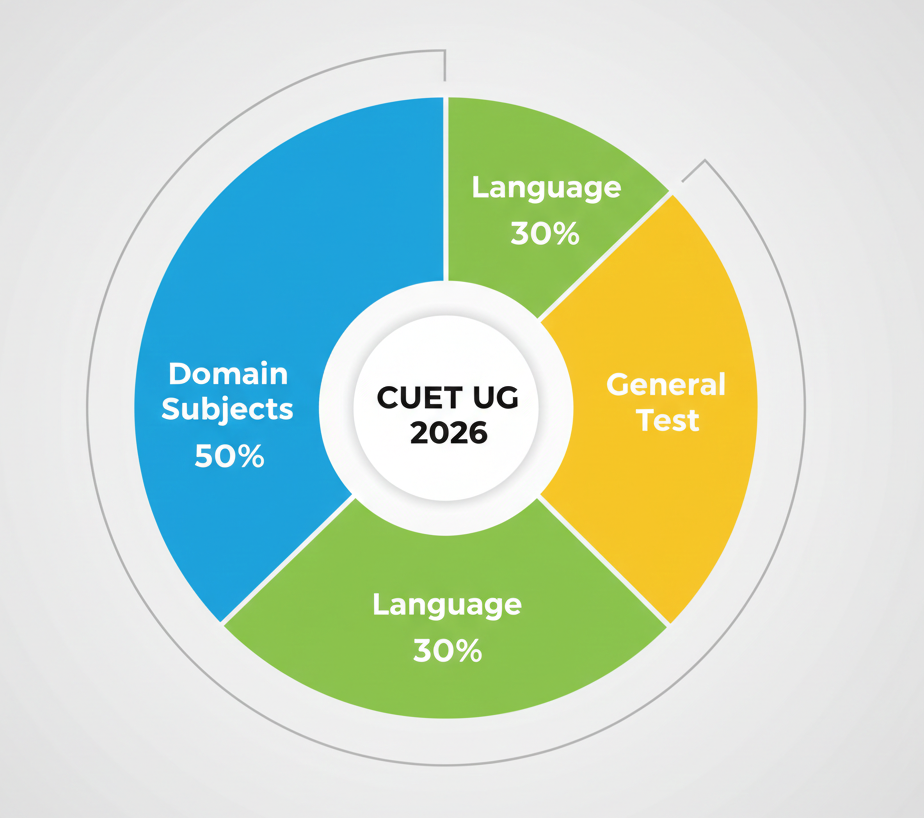
CUET UG 2026 is structured across three sections:
Section I — Language Test: Tests reading comprehension, vocabulary, and language skills. Available in 13 languages: English, Hindi, Bengali, Assamese, Odia, Punjabi, Marathi, Gujarati, Malayalam, Tamil, Telugu, Kannada, and Urdu. Each paper has 50 questions.
Section II — Domain-Specific Subjects: Covers 23 subjects aligned with Class 12 NCERT curriculum, including Physics, Chemistry, Biology, Mathematics, Accountancy, Economics, History, Geography, Political Science, and more. Each paper has 50 questions.
Section III — General Aptitude Test (GAT): Covers general knowledge, current affairs, quantitative aptitude, logical reasoning, and analytical skills. 60 questions in total.
Marking Scheme:
- Correct answer: +5 marks
- Incorrect answer: -1 mark (negative marking applies)
- Duration: 60 minutes per paper (20 extra minutes for PwBD candidates per hour)
- Mode: Computer-Based Test (CBT) only
A key update for 2026: some subjects including Entrepreneurship, Teaching Aptitude, Fashion Studies, Tourism, Legal Studies, and Engineering Graphics have been discontinued as standalone domain subjects. Admissions for those programs will be based on the General Aptitude Test.
Syllabus Overview
The CUET UG 2026 syllabus closely follows the NCERT Class 12 curriculum, which is great news for students already preparing for board exams — the preparation overlaps significantly.
Language Section: Focuses on reading comprehension, vocabulary, grammar, and verbal ability. Reading newspapers, editorials, and literary passages helps build this skill.
Domain Subjects: Subject-specific topics from Class 12 NCERT textbooks. For example, Chemistry covers Organic, Inorganic, and Physical Chemistry as per the Class 12 syllabus. History covers topics like modern Indian history, nationalism, and colonial legacies.
General Test: Covers current affairs (focus on last 6 months), general knowledge, logical reasoning, basic numeracy (up to Class 8 level), and analytical thinking.
NTA has released the official syllabus PDF on cuet.nta.nic.in — download and study it chapter by chapter.
Application Fee Structure
The fee varies by category and the number of subjects chosen. Payments are accepted online only — credit card, debit card, net banking, and UPI are all supported. Applications submitted without successful fee payment are automatically rejected by the system.
Always save your fee payment receipt and the Confirmation Page. These are essential for future reference and during the counselling process.
Participating Universities
CUET UG 2026 scores are accepted by 250+ universities across India, including:
- Central Universities like Delhi University (DU), BHU, JNU, Hyderabad Central University, Jamia Millia Islamia, and AMU
- State universities across Uttar Pradesh, Maharashtra, Rajasthan, and other states
- Deemed universities and select private institutions
With over 46 central universities and hundreds of state and private institutions participating, CUET is genuinely the one exam that opens doors across the country.
Preparation Tips That Actually Work
Start with the NCERT textbooks. Since CUET domain subjects are directly based on Class 12 NCERT content, a thorough revision of your textbooks covers the majority of the syllabus.
Practice mock tests weekly. Attempting full-length mock tests under timed conditions is the single most effective way to build speed and accuracy. NTA provides sample papers on the official website — use them.
Build a current affairs habit. For the General Test, reading a newspaper for 20–30 minutes daily and maintaining a short notes journal on current events (last 6 months) pays dividends.
Don’t ignore the language section. Many students underestimate this section. Practice reading comprehension passages from previous CUET papers and focus on understanding the main idea, vocabulary in context, and inference questions.
Make a subject-wise revision plan. With multiple subjects to cover, a structured weekly plan prevents last-minute cramming. Allocate more time to weaker areas without neglecting strengths.
Solve previous years’ papers. Even though CUET has only been around since 2022, the three-year bank of papers gives you a clear picture of question difficulty and question type frequency.
Common Mistakes to Avoid
Not reading the Information Bulletin carefully. The official bulletin contains subject eligibility rules, document size requirements, and city selection guidelines. Many forms are rejected for skipping this step.
Missing the fee payment deadline. An unfilled form fee is treated as an incomplete application — it will be automatically cancelled. The fee payment deadline has sometimes been tighter than the form submission deadline.
Choosing subjects without checking university requirements. Not all universities accept all subject combinations. A student who picks three domain subjects that don’t match their desired course at a particular university may find themselves ineligible during counselling.
Uploading blurry or incorrectly sized photographs. This is among the most common reasons for application rejection. Ensure your photo is recent, clear, against a plain white background, and meets the prescribed file size.
Leaving the correction window unused. The correction window is your safety net. Use it to double-check your name spelling, date of birth, subject choices, and other critical fields — even if you think your form is perfect.
Key Takeaways
- CUET UG 2026 is conducted by NTA in CBT mode from May 11–31, 2026
- Registration re-opened on February 23, 2026 with a final deadline of February 26, 2026
- No age limit; Class 12 pass or appearing candidates are eligible
- The exam has three sections: Language, Domain Subjects, and General Test
- Syllabus is based on Class 12 NCERT curriculum — board exam prep and CUET prep overlap significantly
- Up to 5 subjects can be chosen; marking scheme is +5 for correct, -1 for incorrect answers
- 250+ universities, including DU, BHU, and JNU, accept CUET scores
- Official website: cuet.nta.nic.in
Conclusion
CUET UG 2026 is more than just another entrance exam — it’s the gateway to some of India’s best universities, and it rewards students who prepare strategically rather than those who simply accumulate high board percentages. Whether you’re aiming for a seat at Delhi University’s top colleges or exploring the wide range of state and deemed universities that now accept CUET scores, the path forward is clear: register before the February 26 deadline, understand the exam pattern, align your prep with the NCERT syllabus, and practice consistently.
The opportunity is genuinely equal for all students. Use it well.
Frequently Asked Questions
1. Is CUET UG 2026 registration still open? Yes. NTA re-opened the registration portal on February 23, 2026. The last date to apply and pay the fee in this special window is February 26, 2026 at 11:50 PM. No correction facility will be available after submission in this final window.
2. How many subjects can I choose for CUET UG 2026? You can choose a maximum of 5 subjects — up to 2 from the Language section, up to 3 Domain Specific Subjects, and optionally the General Aptitude Test (if required by your target university or course).
3. Is there any age limit for CUET UG 2026? No. NTA has not set any upper or lower age limit for appearing in CUET UG 2026. This makes the exam accessible to gap-year students and others returning to education.
4. Are Class 12 board marks considered for admission through CUET? CUET scores are the primary basis for admission at most participating universities. However, some universities may have a minimum Class 12 marks threshold as a basic eligibility filter. Check the specific university’s admission policy.
5. Is the General Test (GAT) compulsory for everyone? No. The General Aptitude Test is only required if the university or course you are applying to specifically demands it. Check the admission requirements of each university you’re targeting.
6. What is the exam language medium for CUET UG 2026? CUET UG 2026 is available in 13 languages: English, Hindi, Bengali, Assamese, Odia, Punjabi, Marathi, Gujarati, Malayalam, Tamil, Telugu, Kannada, and Urdu. Question papers are available in both English and the candidate’s chosen language; the English version prevails in case of any discrepancy.
7. When will CUET UG 2026 results be declared? Results are expected in late July 2026. After results, each participating university will publish its merit list and begin its individual counselling and seat allotment process.