Introduction
If you applied for ME or MTech admission in Gujarat this year, you’re probably refreshing the ACPC website every other hour right now. That’s normal. The gap between “answer key released” and “result declared” is the most stressful part of any entrance exam cycle, and Gujarat PGCET 2026 is no exception.
This guide walks you through everything happening around Gujarat PGCET 2026 right now — how the answer key process works, when the result is expected, who’s eligible, and what you should be doing while you wait. Whether you’re a first-time applicant trying to understand the basics or a repeat candidate tracking counselling dates, you’ll find practical, no-fluff answers here.
Table of Contents
- What is Gujarat PGCET 2026?
- Answer Key: How the Process Works
- Result: Expected Timeline & How to Check
- Eligibility Criteria
- Important Dates at a Glance
- Step-by-Step: From Result to Admission
- Preparation & Post-Exam Tips
- Common Mistakes to Avoid
- Latest Updates & Trends
- Key Takeaways
- Conclusion
- FAQs
1. What is Gujarat PGCET 2026?
Gujarat PGCET (Post Graduate Common Entrance Test) is a state-level entrance exam conducted by the Admission Committee for Professional Courses (ACPC), Gujarat. It’s the gateway for admission into ME, MTech, MPharm, and MPlan programs across Gujarat’s participating institutes.
The exam exists mainly for candidates who don’t hold a valid GATE or GPAT score. If you’re GATE or GPAT qualified, you skip the written test entirely and go straight into PGCET counselling based on your GATE/GPAT score.
Two categories of candidates are involved in this cycle:
- Non-GATE/Non-GPAT candidates — appeared for the PGCET written exam
- GATE/GPAT-qualified candidates — registered for counselling directly, no exam needed
Both groups eventually merge into the same merit list and counselling process, which is why understanding both tracks matters even if you didn’t sit for the test yourself.
2. Answer Key: How the Process Works
ACPC follows a fairly standard two-stage answer key process, and understanding it helps you know exactly where things stand right now.
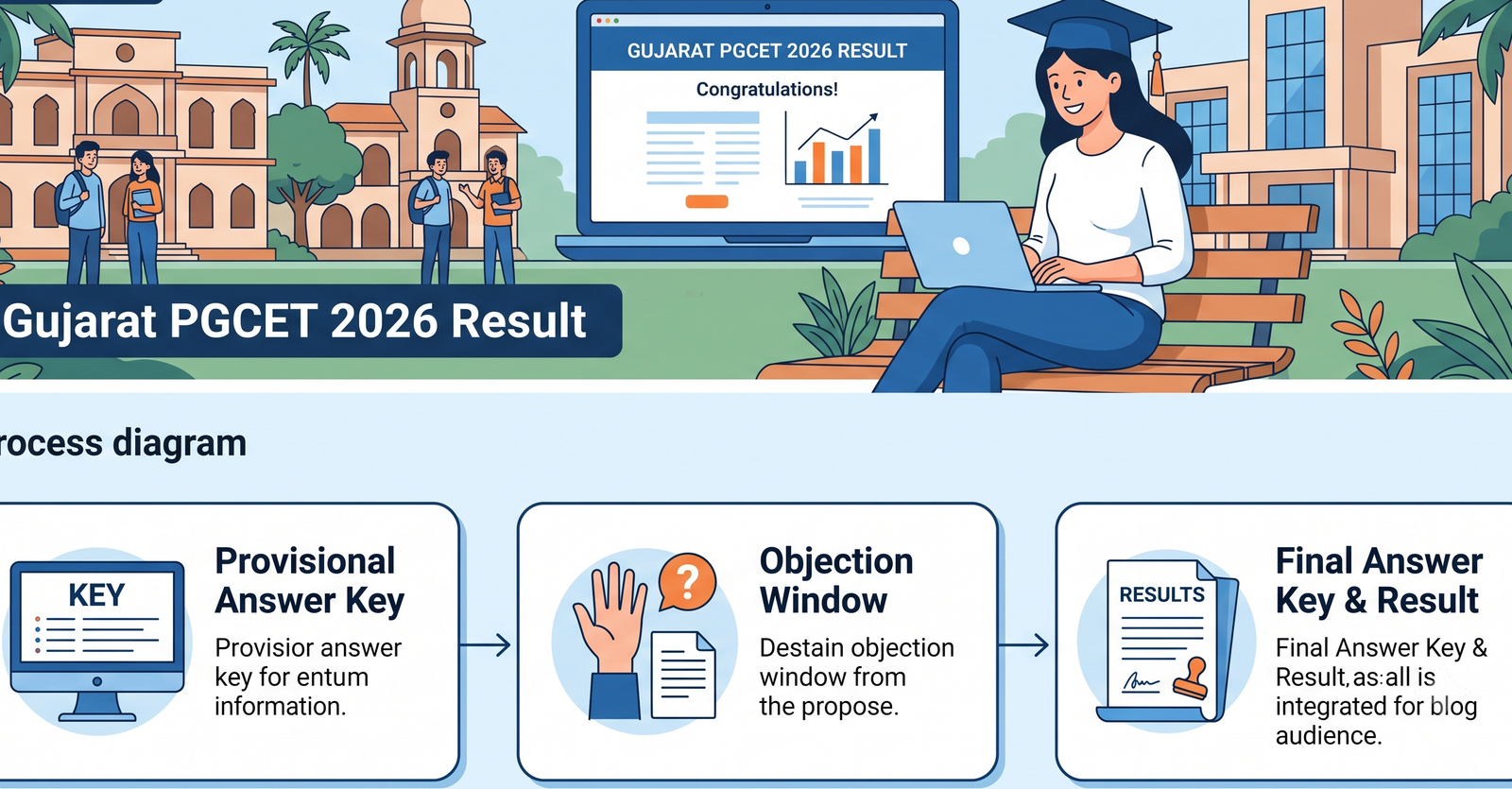
Stage 1 — Provisional Answer Key Released a few days after the exam. This lets candidates match their responses against ACPC’s marked answers and get a rough estimate of their score.
Stage 2 — Objection Window Candidates who spot a discrepancy (a wrong answer, an ambiguous question, or a technical error) can raise an objection. In previous cycles, this window stayed open for about 1–2 days, and objections had to be submitted through a Google Form with the question number and supporting justification — no objection was entertained without proof.
Stage 3 — Final Answer Key After reviewing objections, ACPC publishes the final answer key, which becomes the actual basis for score calculation and the merit list.
Where to check it: The paper-wise answer key PDFs (one for each engineering stream — Civil, Mechanical, Computer Science, Chemical, and so on) are published under the ME/MTech section of the official site, acpc.gujarat.gov.in, and the registration portal gujacpc.admissions.nic.in.
A quick tip from experience: don’t just check your total score against the final key — cross-verify each question you were unsure about, especially in subjects with numerical answers, since a single marking error can shift your rank meaningfully in a competitive list.
3. Result: Expected Timeline & How to Check
Based on ACPC’s usual pattern (and confirmed for this cycle), the Gujarat PGCET 2026 result is expected in July 2026, generally a week or two after the final answer key is published.
How to check your result:
- Visit the official website — acpc.gujarat.gov.in
- Look for the “PGCET 2026 Result” or “Provisional Merit List” link on the ME/MTech section
- Log in using your application/acknowledgement number
- The merit list opens as a PDF — download it and search for your roll number or name
- Save a copy; you’ll need it during counselling and document verification
The result isn’t a simple pass/fail scorecard — it’s released as a category-wise merit list that includes your name, user ID, acknowledgement number, PGCET marks, GATE score (if applicable), and rank. Separate lists are prepared for different reservation categories.
Tie-breaking rule: If two candidates score identically, ACPC first gives preference to whoever has a higher percentage in their qualifying degree. If that’s still tied, more years of relevant work experience break the deadlock.
4. Eligibility Criteria
Before you even get to the result stage, it’s worth double-checking you meet the baseline eligibility — errors here can get an application rejected even after a good score.
- A B.E./B.Tech (or equivalent) degree in a relevant discipline with 50% marks (45% for SC/ST/SEBC/EWS candidates)
- Final-year B.E./B.Tech students awaiting results can also apply, provisionally
- GATE or GPAT-qualified candidates in the relevant discipline are exempt from the written exam but must still register for counselling
- For MPharm: a B.Pharm degree with at least 55% overall (50% for SC/ST/EWS/SEBC candidates)
If your qualifying marksheet has an error or you’re waiting on a corrected one, ACPC allows corrections — but you must submit the revised document at least one day before counselling begins, and within seven days of receiving it from your institute.
5. Important Dates at a Glance
| Event | Status/Window |
|---|---|
| Application form release | Mid-May 2026 |
| Registration window | Mid-May to end of May 2026 |
| Application fee | ₹1,000 per course |
| Admit card release | Early-to-mid June 2026 |
| Written exam (Non-GATE/GPAT) | June–July 2026 |
| Provisional answer key | Within a few days of exam |
| Objection window | 1–2 days after provisional key |
| Final answer key | After objection review |
| Result / provisional merit list | July 2026 |
| Counselling & choice filling | Following result declaration |
Note: ACPC occasionally reschedules exam dates, so always confirm the latest date on the official portal rather than relying on any single third-party source — this article reflects the most recent publicly available schedule at the time of writing.
6. Step-by-Step: From Result to Admission
- Check your result on acpc.gujarat.gov.in using your application number
- Register for counselling if you haven’t already (a separate step from the exam application)
- Fill your choices — list preferred colleges and branches in order of priority
- Track the mock round — ACPC runs a mock seat allotment first so you can gauge realistic cutoffs before the real round
- Adjust your choices based on the mock result if needed
- Wait for actual seat allotment (Round 1, then further rounds for vacant seats)
- Confirm your seat by paying the token amount (typically ₹2,000) within the deadline
- Report to the allotted institute with original documents for final admission
Skipping the fee payment step, even briefly, auto-cancels your candidature — so don’t treat allotment as the finish line.
7. Preparation & Post-Exam Tips
Even if you’ve already written the exam, a few things still matter between now and counselling:
- Re-verify your responses against the final (not provisional) answer key — scores based on the provisional key can shift slightly
- Estimate your rank realistically using previous years’ cutoff trends for your category and branch, not just your raw score
- Keep documents ready in advance — qualifying marksheet, category certificate, ID proof, PGCET admit card — scrambling for these during a short counselling window costs you options
- Research colleges before choice-filling, not during it — decide your priority list (specialization, location, placement record) ahead of time so you’re not guessing under time pressure
If you’re preparing for next year’s cycle or advising a junior, the same fundamentals apply: build a subject-wise study plan around the syllabus, dedicate real time to previous years’ question papers, and treat mock tests as diagnostic tools, not just practice.
8. Common Mistakes to Avoid
- Ignoring the objection window — many candidates don’t bother challenging a wrong answer even when they’re confident, assuming it won’t matter. In a ranked list, even one mark can move you dozens of ranks.
- Not registering separately for counselling — clearing the exam doesn’t automatically enrol you in counselling; it’s a distinct registration step.
- Submitting incomplete or uncertified documents during choice filling, leading to rejection at verification
- Missing the seat confirmation fee deadline, which cancels your allotted seat automatically
- Relying on outdated cutoff data from two or three years ago instead of the most recent round-wise cutoffs
9. Latest Updates & Trends
The 2026 cycle has followed a slightly compressed timeline compared to some previous years, with registration closing by the end of May and the exam and results both expected to wrap by mid-to-late July. ACPC has also continued its now-standard practice of releasing paper-wise answer keys (rather than one combined key), which makes it easier for candidates to isolate errors specific to their stream.
One trend worth noting: competition for computer science and mechanical engineering seats has stayed high in recent cycles, while some emerging specializations have seen relatively softer cutoffs — worth factoring into your choice-filling strategy if you have flexibility in your branch preference.
Key Takeaways
- Gujarat PGCET 2026 is conducted by ACPC for non-GATE/non-GPAT ME/MTech/MPharm/MPlan aspirants
- The answer key process has three stages: provisional → objection → final
- Result is expected as a category-wise merit list in July 2026 on acpc.gujarat.gov.in
- Eligibility requires 50% (45% for reserved categories) in a relevant B.E./B.Tech degree
- Counselling is a separate registration step — clearing the exam alone doesn’t enrol you
- Always verify dates on the official portal, since ACPC schedules can shift
Conclusion
The wait between the answer key and the result is genuinely the hardest part of this process — but it’s also the best window to get organized. Use it to verify your answer key score, get your documents in order, and research your college choices properly instead of doing it under counselling-day pressure. Once the Gujarat PGCET 2026 result is out, things move fast, and candidates who prepared during the waiting period consistently have a smoother counselling experience than those scrambling afterward.
FAQs
1. When will the Gujarat PGCET 2026 result be declared? The result is expected in July 2026 as a provisional merit list on acpc.gujarat.gov.in, generally released after the final answer key.
2. How do I check the Gujarat PGCET 2026 final answer key? Visit acpc.gujarat.gov.in, go to the ME/MTech section, and download the paper-wise answer key PDF for your specific stream.
3. What is the minimum eligibility for Gujarat PGCET 2026? A B.E./B.Tech degree with 50% marks (45% for SC/ST/SEBC/EWS candidates) in a relevant discipline.
4. Do GATE-qualified candidates need to take the Gujarat PGCET exam? No. GATE and GPAT-qualified candidates are exempt from the written test and go directly into counselling based on their GATE/GPAT score.
5. Can I challenge the Gujarat PGCET 2026 answer key? Yes. ACPC opens a short objection window after the provisional key is released, where you can submit challenges with supporting justification through a Google Form.
6. What documents are needed for Gujarat PGCET counselling? Your qualifying degree marksheet, category certificate (if applicable), PGCET admit card, photo ID, and any GATE/GPAT scorecard if relevant.
7. What happens if I miss the seat confirmation fee deadline? Your allotted seat gets automatically cancelled, so it’s important to pay the confirmation fee within the specified window after seat allotment.