Introduction
If you’ve been refreshing government job portals every morning hoping for a fresh banking opportunity, here’s some good news. Indian Overseas Bank has just opened its IOB Apprentice Online Form 2026, and it’s one of the biggest apprenticeship drives this year with 750 vacancies up for grabs.
Whether you’re a fresh graduate figuring out your first career move or someone who’s been eyeing a banking job for a while, this guide walks you through everything — the exact dates, who can apply, how to apply, exam pattern, stipend details, and a realistic preparation plan. No fluff, just the details you actually need before you hit submit.
Table of Contents
- What Is IOB Apprentice Recruitment 2026?
- Important Dates You Can’t Miss
- Eligibility Criteria Explained
- Step-by-Step Application Process
- Application Fee Details
- Selection Process & Exam Pattern
- Stipend and Benefits
- Preparation Tips & Best Practices
- Common Mistakes to Avoid
- Latest Trends & Updates
- Key Takeaways
- FAQs
What Is IOB Apprentice Recruitment 2026?
Indian Overseas Bank (IOB), a public sector bank headquartered in Chennai, has released its official notification (reference number HRDD/APPR/01/2026-27) to engage 750 apprentices for the financial year 2026-27 under the Apprentices Act, 1961. This isn’t a permanent job offer — it’s a structured, one-year training program designed to give graduates hands-on exposure to banking operations, with a monthly stipend along the way.
Think of it as a launchpad. Many candidates who complete apprenticeships at PSU banks go on to appear for regular clerk or PO exams with a genuine edge, since they already understand branch-level banking workflows.
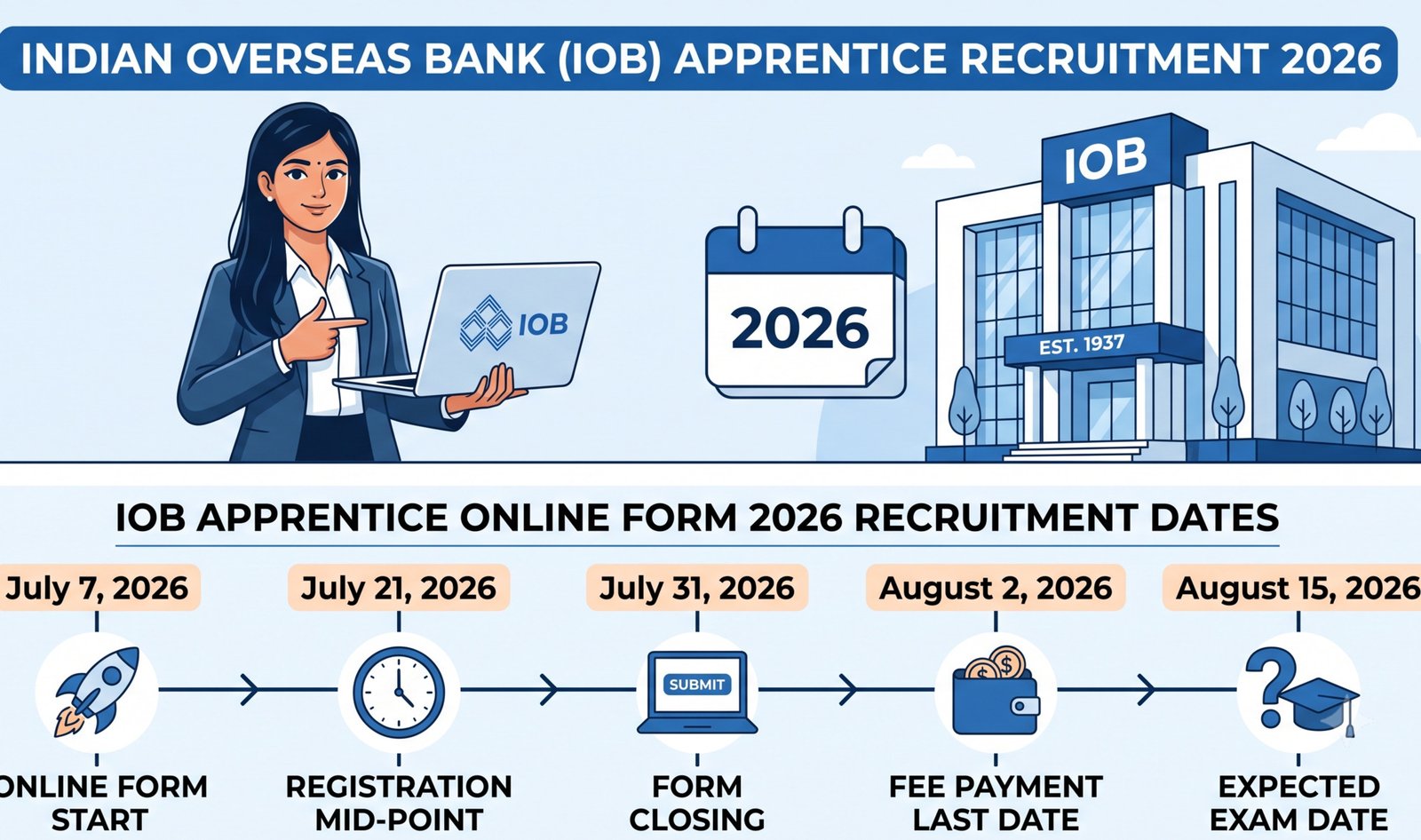
Important Dates You Can’t Miss
Here’s the complete timeline for IOB Apprentice 2026:
| Event | Date |
|---|---|
| Notification Release | 6 July 2026 |
| Online Application Start | 7 July 2026 |
| Last Date to Apply Online | 20 July 2026 |
| Graduation Result Deadline | On or before 31 July 2026 |
| Tentative Online Exam Date | 2 August 2026 |
That gives you roughly two weeks to complete your registration — not a lot of time, so don’t leave it for the last day. Portals tend to slow down or crash when thousands of candidates log in simultaneously near the deadline.
Eligibility Criteria Explained
Before you start filling the form, make sure you tick every box below.
Nationality
You must be a citizen of India.
Age Limit
- Minimum age: 20 years
- Maximum age: 28 years
- Age is calculated as on 1 July 2026
- For General/EWS candidates, date of birth should fall between 1 July 1998 and 1 July 2006 (both inclusive)
Age relaxation:
- SC/ST candidates: 5 years
- OBC candidates: 3 years
- PwBD candidates: as per government norms
Educational Qualification
- A graduation degree in any discipline from a university recognized by the Government of India
- Result must be declared on or before 31 July 2026
- NATS-registered candidates need their graduation result declared between 1 March 2022 and 31 July 2026
Apprenticeship Portal Registration
This is where many candidates trip up. You must register on either the NATS (National Apprenticeship Training Scheme) or NAPS (National Apprenticeship Promotion Scheme) portal before filling the IOB application. You’ll need your enrollment number handy — the bank’s form won’t accept your application without it.
Local Language
Candidates must be proficient in one of the local/regional languages of the state they’re applying for, since a language test is part of the selection process.
Step-by-Step Application Process
Here’s the practical, no-confusion way to apply:
- Register on NATS or NAPS — whichever applies to your graduation year — and note down your enrollment number.
- Visit the BFSI SSC / BEEP portal and locate “IOB Apprenticeship Program FY 2026-27.”
- Create your login using a valid email ID and mobile number.
- Enter your NATS/NAPS enrollment number in the application form.
- Fill in personal, educational, and state preference details carefully — you can apply to only one state/UT, so choose wisely.
- Upload documents, including your photograph and signature, in the prescribed format and size.
- Pay the application fee via UPI, debit card, or credit card.
- Review everything twice before final submission — corrections after submission are usually not allowed.
- Download and save a printed or soft copy of your submitted form for future reference.
Practical tip: Keep your documents ready in PDF/JPEG format before you start the form. Scrambling to scan a photo mid-application is how most people run into avoidable errors.
Application Fee Details
| Category | Fee |
|---|---|
| SC/ST/PwBD | ₹236 |
| General/OBC/EWS (Female) | ₹708 |
| General/OBC/EWS (Male) | ₹944 |
Fees are non-refundable, so double-check your category and details before paying.
Selection Process & Exam Pattern
Selection happens in stages:
- Online Written Examination
- Local Language Test (wherever applicable)
- Document Verification / Personal Interaction
- Medical Fitness Verification
Exam Pattern
- Total questions: 100
- Total marks: 100
- Duration: 90 minutes
- Question type: Objective (MCQ)
Section-wise breakup:
- General/Financial Awareness — 25 marks
- General English
- Quantitative & Reasoning Aptitude
- Computer Knowledge
There’s no minimum qualifying mark per section, but you do need to clear the overall aggregate cut-off set by the bank. SC/ST/OBC/PwBD candidates get a 5% relaxation in the aggregate qualifying marks. Some sources indicate negative marking may apply for wrong answers, so accuracy matters as much as speed.
Stipend and Benefits
Selected apprentices receive a monthly stipend for the one-year training period, varying by branch location:
- Metro branches: ₹15,500/month
- Urban branches: ₹14,500/month
- Semi-Urban/Rural branches: ₹14,000/month
This stipend may include a government subsidy component where applicable. Keep in mind: apprentices are not treated as regular bank employees, and the bank isn’t obligated to offer permanent employment after the training period ends. It’s a learning opportunity first, not a guaranteed job.
Preparation Tips & Best Practices
If you’re serious about clearing the written exam in your first attempt, here’s a realistic 4-week approach:
- Quant & Reasoning: Practice 25 questions daily, focusing on speed without sacrificing accuracy. Number series, simplification, and simple/compound interest are common recurring topics.
- English: Work on error spotting, cloze tests, and reading comprehension — these are scoring sections if your grammar basics are solid.
- General/Financial Awareness: Revise current banking news, RBI policies, government schemes, and basic financial terms. Following a daily current affairs digest helps more than cramming.
- Computer Knowledge: Cover MS Office basics, internet fundamentals, hardware/software concepts, and cybersecurity basics.
- Mock tests: Take at least one full-length mock every week to build exam-day stamina and identify weak areas early.
Real-world insight: Candidates who’ve cleared similar bank apprentice exams (like Union Bank’s 2026 drive) often say the biggest differentiator isn’t raw knowledge — it’s time management within the 90-minute window. Practicing under timed conditions matters as much as content revision.
Common Mistakes to Avoid
- Skipping NATS/NAPS registration first — your IOB form won’t go through without a valid enrollment number.
- Applying to multiple states — you’re only allowed one state/UT preference, so pick strategically based on where you’re comfortable with the local language.
- Uploading wrong document formats — check size and format requirements before uploading photo/signature.
- Waiting until the last day — portal traffic spikes near deadlines, increasing your risk of technical glitches.
- Ignoring the local language requirement — if you’re weak in the regional language of your chosen state, this could cost you at the language test stage.
Latest Trends & Updates
Bank apprenticeship drives have become increasingly popular launch points for banking careers in 2026, with Union Bank of India also recently concluding a large apprentice drive for 1,865 posts. This signals that public sector banks are leaning more on structured apprenticeship pipelines — a good sign for candidates who want practical training before attempting full-fledged PO/Clerk exams. Staying updated on multiple bank apprentice notifications (rather than betting on just one) is a smart strategy for serious aspirants this recruitment season.
Key Takeaways
- IOB Apprentice 2026 offers 750 vacancies; apply online between 7–20 July 2026.
- Age limit: 20–28 years as on 1 July 2026 (with category-wise relaxations).
- Graduation in any discipline is enough — no specific stream required.
- NATS/NAPS registration is mandatory before applying on the BFSI SSC portal.
- Exam is 100 marks, 90 minutes, objective-type, tentatively on 2 August 2026.
- Stipend ranges from ₹14,000–₹15,500/month depending on branch category.
Conclusion
The IOB Apprentice 2026 recruitment is a genuine opportunity for graduates to step into the banking sector, gain real experience, and build a foundation for future banking exams — all while earning a monthly stipend. The window is short, so if you meet the eligibility criteria, don’t wait around. Register on NATS/NAPS today, gather your documents, and submit your form well before 20 July 2026.
FAQs
1. When will the IOB Apprentice 2026 online form close?
The last date to apply online is 20 July 2026.
2. What is the age limit for IOB Apprentice Recruitment 2026?
Candidates must be between 20 and 28 years as on 1 July 2026, with relaxations for reserved categories.
3. Is NATS or NAPS registration compulsory for IOB Apprentice 2026?
Yes, candidates must register on either the NATS or NAPS portal and enter their enrollment number in the IOB application form.
4. What is the application fee for IOB Apprentice 2026?
₹236 for SC/ST/PwBD, ₹708 for General/OBC/EWS female candidates, and ₹944 for General/OBC/EWS male candidates.
5. How many questions are asked in the IOB Apprentice exam?
The exam has 100 objective-type questions worth 100 marks, to be completed in 90 minutes.
6. What stipend will IOB apprentices receive?
Between ₹14,000 and ₹15,500 per month, depending on the branch location (metro, urban, or semi-urban/rural).
7. Will IOB apprentices get a permanent job after training?
Not guaranteed. Apprentices are not treated as regular employees, and the bank has no obligation to offer permanent employment post-training.