Introduction
If your child is in Class 5 right now and you’re dreaming of a free, high-quality residential education for them, the NVS Class 6 Online Form 2027-28 is your gateway. Navodaya Vidyalaya Samiti (NVS) has already opened applications for the Jawahar Navodaya Vidyalaya Selection Test (JNVST) 2027, and the window is short — so timing matters more than ever this year.
In this guide, you’ll learn:
- The exact application dates and exam schedule for 2027-28
- Who is eligible (age limit, class, and residence rules)
- Documents you need before you start filling the form
- A step-by-step walkthrough of the application process
- Exam pattern, preparation tips, and common mistakes to avoid
Let’s get straight into it.
Table of Contents
- What Is NVS Class 6 Admission?
- NVS Class 6 Online Form 2027-28: Important Dates
- Eligibility Criteria for JNVST 2027
- Documents Required
- Step-by-Step Application Guide
- Exam Pattern and Syllabus
- Benefits of Studying in a Navodaya Vidyalaya
- Preparation Tips and Best Practices
- Common Mistakes to Avoid
- Latest Updates and Trends
- Key Takeaways
- Conclusion
- FAQs
What Is NVS Class 6 Admission?
Jawahar Navodaya Vidyalayas (JNVs) are fully residential, co-educational schools run by the Government of India under the Ministry of Education. They’re built to give talented children — especially from rural areas — access to quality, CBSE-affiliated education completely free of cost, including boarding, meals, uniforms, and books.
Admission to Class 6 happens through a single national-level entrance exam: the Jawahar Navodaya Vidyalaya Selection Test (JNVST). It’s one of the most competitive entrance exams at the primary level in India, simply because there’s usually only one seat available for every few hundred applicants in a district.
NVS Class 6 Online Form 2027-28: Important Dates
The Navodaya Vidyalaya Samiti has officially released the notification and prospectus for the 2027-28 academic session. Here’s what you need to know:
| Event | Date |
|---|---|
| Online application start | July 6, 2026 |
| Last date to apply | July 31, 2026 |
| Correction window | A few days after the deadline (usually 3-5 days) |
| Admit card release | Communicated later, typically 15-20 days before the exam |
| JNVST 2027 exam date | November 28, 2026 |
| Reporting time at centre | By 11:00 AM |
| Result declaration | Expected by end of March 2027 |
A quick tip: don’t wait until the last week of July to apply. Servers slow down considerably in the final 48 hours, and last-minute document upload errors are the number one reason forms get rejected.
Eligibility Criteria for JNVST 2027
Before you fill the NVS Class 6 online form, make sure your child ticks every box below. NVS is strict about eligibility, and even a small mismatch can lead to disqualification later.
Age Limit
- The candidate must be born between May 1, 2015, and July 31, 2017 (both dates inclusive).
- There’s no age relaxation for any category, including SC/ST/OBC or Divyang candidates.
Educational Qualification
- The child must be currently studying in Class 5 during the 2026-27 academic session in a government, government-aided, or otherwise recognized school.
- Students who complete NIOS’s “B” certificate before the cut-off date are also eligible.
Residence Rule
- Applications must be submitted for the district where the child is currently studying in Class 5 — not necessarily the family’s home district.
- For the rural quota, the candidate must have studied Classes 3, 4, and 5 in a rural-area school in the same district.
One-Attempt Rule
- JNVST can be attempted only once in a lifetime. If a child has appeared for it before, they cannot reapply, even under a different district or category.
Reservation
- At least 75% of seats in every district are reserved for rural candidates.
- Reservation also applies for SC, ST, OBC, and Divyang (differently-abled) candidates as per government norms.
Documents Required
Keep these ready as scanned JPG files (usually between 10 KB and 100 KB) before you sit down to fill the form:
- Recent passport-size photograph of the candidate
- Signature of the student and a parent/guardian
- Aadhaar card or a valid residence certificate
- Class 5 studying/enrollment certificate
- Category certificate (SC/ST/OBC non-creamy layer, if applicable)
- Disability certificate from a competent authority, if applying under the Divyang category
- Rural status certificate (for NIOS students claiming the rural quota)
Practical tip: scan all documents in advance and save them in a single folder on your phone or computer. This alone saves a lot of last-minute panic.
Step-by-Step Application Guide
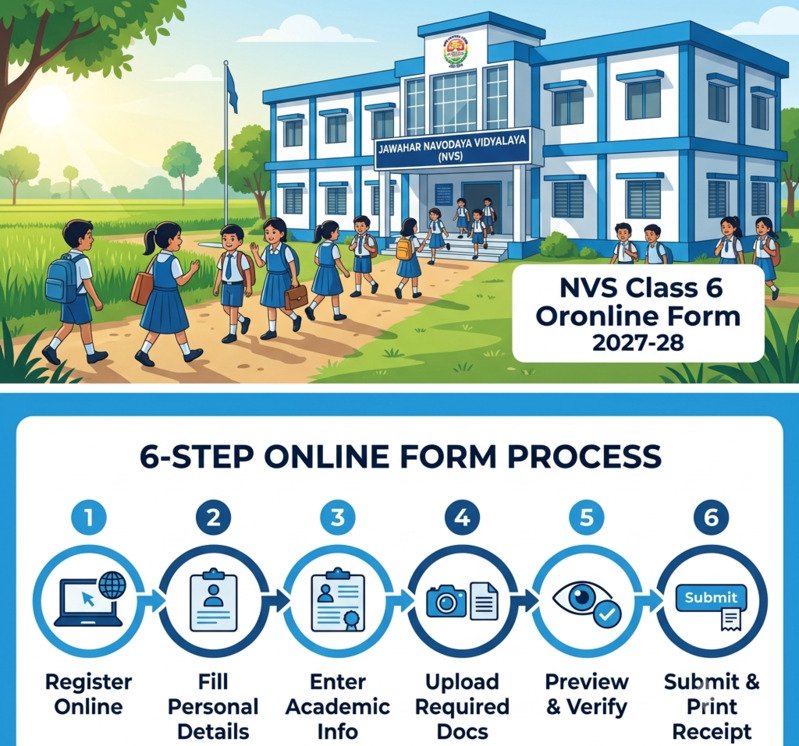
Here’s exactly how to fill the NVS Class 6 Online Form 2027-28:
- Visit the official portal — the application link is hosted at cbseitms.rcil.gov.in/nvs, and the notification is also mirrored on navodaya.gov.in.
- Read the prospectus carefully. This document lists district-specific instructions, so don’t skip it.
- Register using the candidate’s basic details — name, date of birth, gender, and category.
- Fill in academic details such as the current school, state, district, block, Aadhaar number, APAAR ID, and PEN (Permanent Education Number), where applicable.
- Upload documents in the specified format and size.
- Choose the exam language. This cannot be changed later, so pick carefully based on the medium of instruction your child is comfortable with.
- Review every field — name spelling, date of birth, and category especially — before hitting submit.
- Submit and download the confirmation page. Keep the application number safe; you’ll need it to download the admit card and check results later.
There is no application fee for any category. If any website or agent asks you to pay for the NVS Class 6 form, it’s a scam — report it and use only the official portal.
Exam Pattern and Syllabus
The JNVST Class 6 paper is designed to be simple in language but tricky in logic. Here’s the structure:
- Total questions: 80 objective-type (multiple choice)
- Total marks: 100
- Negative marking: None
- Answer sheet: OMR sheet, marked only with a blue or black ballpoint pen
Section-Wise Breakdown
- Mental Ability Test (MAT) — the largest and most heavily weighted section. Covers figure matching, analogy, odd-man-out, embedded figures, pattern completion, and mirror images.
- Arithmetic Test (AT) — covers numbers and numeral systems, LCM/HCF, decimals, fractions, simple measurement, and basic geometry.
- Language Test — 20 questions based on reading comprehension passages, testing vocabulary and grammar rather than rote memorization.
Candidates must qualify in all three sections individually, not just score well overall, to be considered for the merit list.
Benefits of Studying in a Navodaya Vidyalaya
Parents often ask, “Is it really worth the effort?” Here’s why lakhs of families apply every year:
- Completely free education — tuition, hostel, food, uniforms, and textbooks are all covered.
- CBSE affiliation with strong academic outcomes and disciplined routines.
- Exposure and exchange programs, including the Navodaya-to-Navodaya student exchange between different states.
- Access to sports, arts, and vocational training alongside academics.
- A level playing field for rural and economically weaker students who otherwise might not get access to residential schooling.
Preparation Tips and Best Practices
- Start with the Mental Ability Test. It carries the highest weight, and most children find it unfamiliar at first because schools rarely teach this kind of reasoning.
- Practice with a timer. With 80 questions to attempt in a fixed duration, speed matters as much as accuracy.
- Use previous years’ question papers. Pattern recognition genuinely improves with repeated exposure to real questions.
- Don’t ignore the Language Test. Many students focus only on maths and reasoning, then lose easy marks here.
- Revise NCERT Class 3-5 concepts for arithmetic — the syllabus doesn’t go beyond what’s taught in these grades.
- Do a few full-length mock tests in the last month to build exam-day stamina.
Common Mistakes to Avoid
- Applying under the wrong district — remember, it’s the district of the current school, not the family’s native place.
- Choosing the wrong exam language and realizing later it can’t be changed.
- Uploading blurry or oversized documents, which causes rejection during verification.
- Missing the correction window. If you spot an error after submission, the correction period is your only chance to fix non-critical details like address or exam centre.
- Falling for fake websites or agents demanding a “processing fee.” NVS never charges anything for this application.
- Waiting till the deadline. Server load spikes in the last few days, and OTP or payment gateway glitches (even for free forms, verification steps can lag) are common.
Latest Updates and Trends
- NVS has been steadily digitizing the entire process — Aadhaar-based verification and APAAR ID integration are recent additions aimed at reducing fraudulent or duplicate applications.
- The 75% rural quota and one-attempt rule continue to be strictly enforced, with NVS cross-checking data against previous years’ applicants to catch repeat attempts.
- Result declaration timelines have become more consistent, generally falling in March, right before the new academic session begins in April.
Key Takeaways
- The NVS Class 6 Online Form 2027-28 application window is July 6 to July 31, 2026.
- The JNVST 2027 exam is scheduled for November 28, 2026.
- Candidates must be born between May 1, 2015, and July 31, 2017, and currently studying in Class 5.
- The application is completely free — never pay anyone claiming otherwise.
- The exam has three sections — MAT, Arithmetic, and Language — with no negative marking.
- Results are expected by end of March 2027.
Conclusion
The NVS Class 6 Online Form 2027-28 opens the door to one of India’s most respected residential school systems, and the process itself isn’t complicated once you know the timeline and requirements. What matters most is applying early, keeping documents ready in advance, and giving your child focused practice on the Mental Ability Test well before November. If you follow the steps in this guide, you’ll avoid the common pitfalls that trip up thousands of applicants every year — and give your child a fair shot at a seat that could shape their entire education.
FAQs
1. When does the NVS Class 6 Online Form 2027-28 close? The last date to submit the application is July 31, 2026.
2. What is the age limit for JNVST Class 6 admission 2027? Candidates must be born between May 1, 2015, and July 31, 2017 (both dates inclusive).
3. Is there any application fee for the NVS Class 6 form? No, the application is completely free for all categories, including General, OBC, SC, ST, and Divyang.
4. When is the JNVST 2027 exam date? The exam is scheduled for November 28, 2026, for both summer-bound and winter-bound Navodaya Vidyalayas.
5. Can a student apply for JNVST a second time if they didn’t clear it earlier? No. JNVST can be attempted only once in a lifetime; repeat attempts are disqualified.
6. Which district should I select while applying? You must apply for the district where your child is currently studying in Class 5, not necessarily your permanent residence.
7. When will the JNVST 2027 result be announced? The result is expected to be declared by the end of March 2027 through the official NVS portal.