Introduction
If you appeared for the CBSE Class 10 Phase 2 exam this year, you’re probably refreshing cbseresults.nic.in every few hours right now. You’re not alone — over 6.68 lakh students sat for this year’s second board exam, and everyone wants to know the same three things: when the result drops, what the marksheet symbols mean, and whether their score will actually count.
This year is different from every year before it. For the first time, CBSE ran two board exams for Class 10 under the National Education Policy 2020 — one compulsory exam in February-March, and one optional improvement exam in May. That’s a big shift, and it comes with new rules, new terminology, and a fair bit of confusion.
In this guide, you’ll learn everything about the CBSE 10th Result 2026 second exam — the confirmed dates, what the grading symbols on your marksheet mean, who was eligible to sit for Phase 2, and the exact steps and documents you need to download your result without hassle. Let’s get into it.
Table of Contents
- Why CBSE Introduced a Second Board Exam
- CBSE 10th Second Exam 2026: Key Dates
- Who Was Eligible for the Phase 2 Exam
- How the Final Result Is Calculated (Best-of-Two Policy)
- Marksheet Symbols and Grading System Explained
- Step-by-Step: How to Check Your CBSE 10th Result 2026
- Important Documents and Requirements
- What to Do If You Still Don’t Clear the Exam
- Common Mistakes Students Make
- Tips and Best Practices for Result Day
- Key Takeaways
- Conclusion
- FAQs
1. Why CBSE Introduced a Second Board Exam
Under NEP 2020, CBSE moved to a two-exam format for Class 10 to reduce the “one-shot” pressure that has defined board exams in India for decades. The idea is simple: give students a genuine second chance to improve their marks in the same academic year, instead of waiting an entire year to retake an exam.
Here’s how it works in practice:
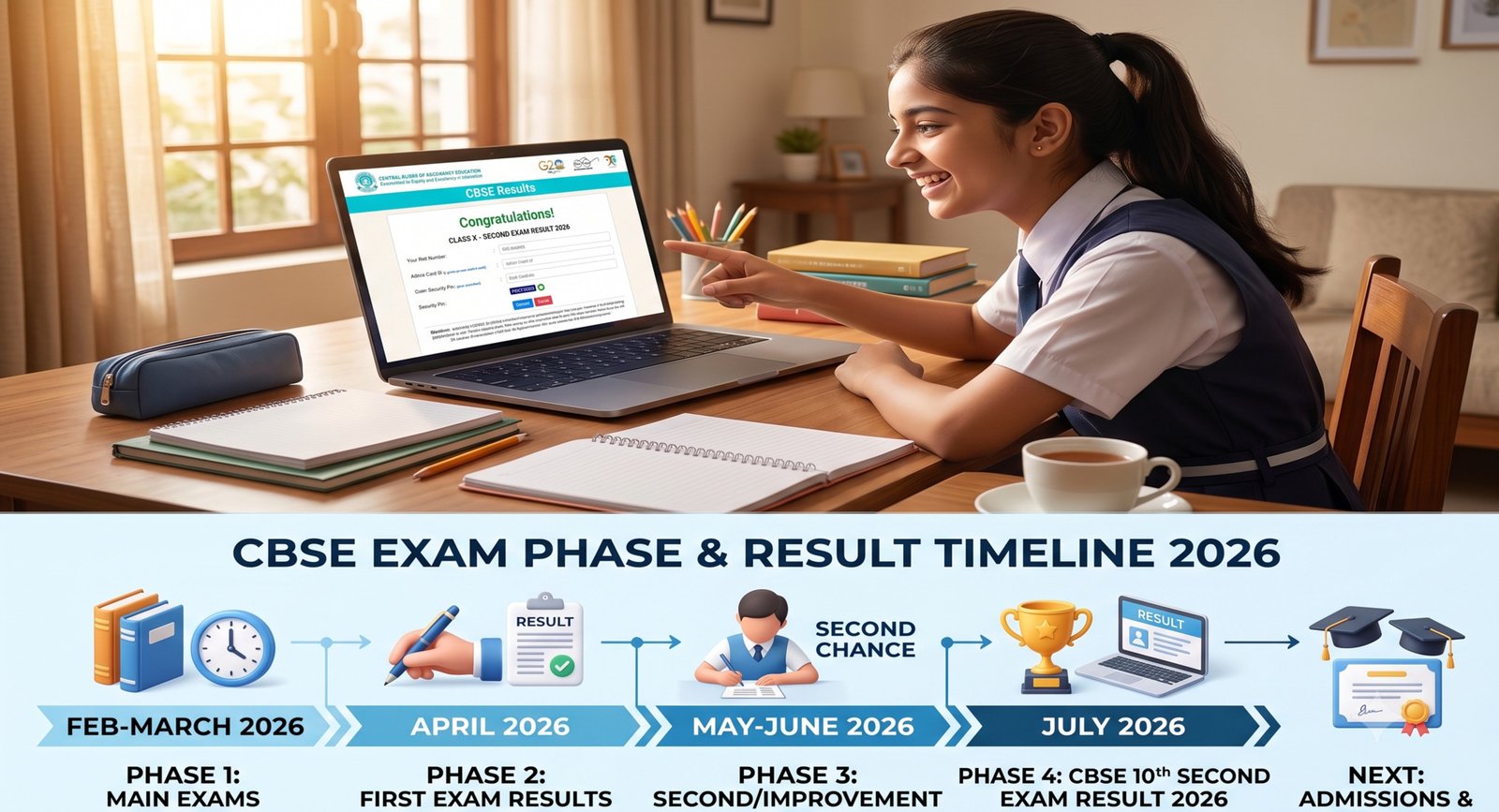
- Phase 1 (February–March): Compulsory for every registered student. This is the main board exam.
- Phase 2 (May): Optional. Students can appear in up to three subjects — typically Mathematics, Science, Social Science, or a language — to try and improve their Phase 1 score.
This isn’t a “supplementary” or “compartment” exam in the old sense. It’s an improvement opportunity built into the system, open to students who passed Phase 1 as well as those who didn’t.
2. CBSE 10th Second Exam 2026: Key Dates
Here’s the confirmed and expected timeline for this year’s cycle:
| Event | Date |
|---|---|
| Phase 1 (main) board exam | February 17 – March 11, 2026 |
| Phase 1 result declared | April 15, 2026 (pass percentage: 93.70%) |
| Phase 2 (second/improvement) exam | May 15 – May 21, 2026 |
| On-screen evaluation completed | June 1, 2026 |
| DigiLocker integration confirmed | June 3, 2026 |
| Phase 2 result | Expected by June 30–early July 2026 |
| Compartment exam (for those who don’t clear) | Expected July 2026 |
| Compartment result | Expected August 2026 |
Senior CBSE officials, including the Controller of Examinations, have publicly stated the board is targeting June 30, 2026 to close the entire Phase 2 cycle so schools can move ahead with Class 11 admissions without delay. As of the date of this update, an official notification confirming the exact result date had not yet been issued — students should treat this as the most reliable expected window rather than a locked date.
Practical tip: CBSE does not send individual notifications when results go live. Bookmark cbseresults.nic.in and check it directly rather than relying on third-party apps for the first link, since those sites often get overloaded or show cached/incorrect data on result day.
3. Who Was Eligible for the Phase 2 Exam
Not every Class 10 student needed to appear for Phase 2. Eligibility broke down into three groups:
- Improvement candidates: Students who passed Phase 1 but wanted a better score in up to three subjects. Over 5.25 lakh students fell into this category this year.
- Compartment candidates: Students placed in “compartment” after Phase 1 (meaning they failed one subject) were required to clear that subject in Phase 2 to pass overall. Around 85,285 students appeared under this category.
- Absentee candidates: Students who missed Phase 1 due to genuine reasons (medical emergencies, etc.) with prior CBSE approval could also appear in Phase 2 as their primary attempt.
If you appeared in Phase 1 and were satisfied with your marks, Phase 2 was entirely optional — there was no requirement or penalty either way.
4. How the Final Result Is Calculated (Best-of-Two Policy)
This is the part that confuses most students and parents, so let’s break it down clearly.
CBSE uses a best-of-two approach for the final marksheet. For every subject you attempted in both phases, the board keeps whichever score is higher.
Example 1: You scored 70 in Phase 1 Maths and 80 in Phase 2 Maths → your final marksheet shows 80.
Example 2: You scored 70 in Phase 1 Science and 60 in Phase 2 Science → your final marksheet retains the original 70.
The key rule to remember: appearing for Phase 2 can only help your score, never hurt it. This removes the fear factor that used to stop students from attempting improvement exams in the old system.
For compartment students, if you clear the subject in Phase 2, your qualification status updates directly in the final marksheet — you don’t need a separate certificate for that subject.
5. Marksheet Symbols and Grading System Explained
CBSE marksheets use short codes and grade letters that often confuse first-time readers. Here’s what they mean:
Common Symbols
- RL – Result Later (usually due to pending verification; contact your school)
- RW – Result Withheld (similar reason; requires school-level clarification)
- CGPA – Cumulative Grade Point Average, shown instead of a raw percentage
- XXX – Sometimes used to denote an absent candidate in a subject
If you see RL or RW on your scorecard, don’t panic. These are typically resolved within a few days once your school verifies your details with the CBSE regional office.
Grading Scale (9-Point System)
CBSE uses a 9-point grading scale from A1 (highest) to E (needs improvement/fail):
| Grade | Marks Range | Grade Point |
|---|---|---|
| A1 | 91–100 | 10 |
| A2 | 81–90 | 9 |
| B1 | 71–80 | 8 |
| B2 | 61–70 | 7 |
| C1 | 51–60 | 6 |
| C2 | 41–50 | 5 |
| D | 33–40 | 4 |
| E | Below 33 | Needs improvement |
Converting CGPA to Percentage
Your marksheet shows a CGPA, not a straight percentage. Here’s the formula:
CGPA = Sum of Grade Points of 5 main subjects ÷ 5
To estimate your percentage: Percentage = CGPA × 9.5
For example, a CGPA of 9.2 works out to roughly 87.4%. This isn’t an official conversion for legal use, but it’s the standard formula students and schools use for quick reference.
Passing Marks
To pass, a student needs:
- 33% in each subject, broken down as 27 out of 80 in theory and 7 out of 20 in practical/internal assessment
- 33% combined across theory and internal assessment per subject
6. Step-by-Step: How to Check Your CBSE 10th Result 2026
Method 1: Official Website
- Go to cbseresults.nic.in.
- Click on “Secondary School Examination Results 2026 – Phase II.”
- Enter your Roll Number, School Number, Admit Card ID, and Date of Birth exactly as printed on your admit card.
- Complete the captcha and click Submit.
- Your result will display on screen — download it and take a screenshot or printout for safekeeping.
Method 2: DigiLocker (Digitally Signed Copy)
- Open the DigiLocker app or website.
- Log in using your Aadhaar-linked mobile number.
- Go to Education → Central Board of Secondary Education.
- Select “Class 10 Marksheet” and choose 2026 as the year.
- Download your digitally signed document — this version can be used for official purposes, unlike the preliminary online result.
Method 3: UMANG App
- Download UMANG from the Play Store or App Store.
- Search for “CBSE” and select the Class 10 result service.
- Enter your login credentials and submit.
- Your result appears on screen; download and save it.
Method 4: SMS
Type: CBSE10 [space] Roll Number [space] Date of Birth [space] School Number [space] Centre Number Send it to 7738299899. Your marks arrive by return SMS — useful if you don’t have stable internet on result day.
7. Important Documents and Requirements
Keep these ready before result day so you’re not scrambling at the last minute:
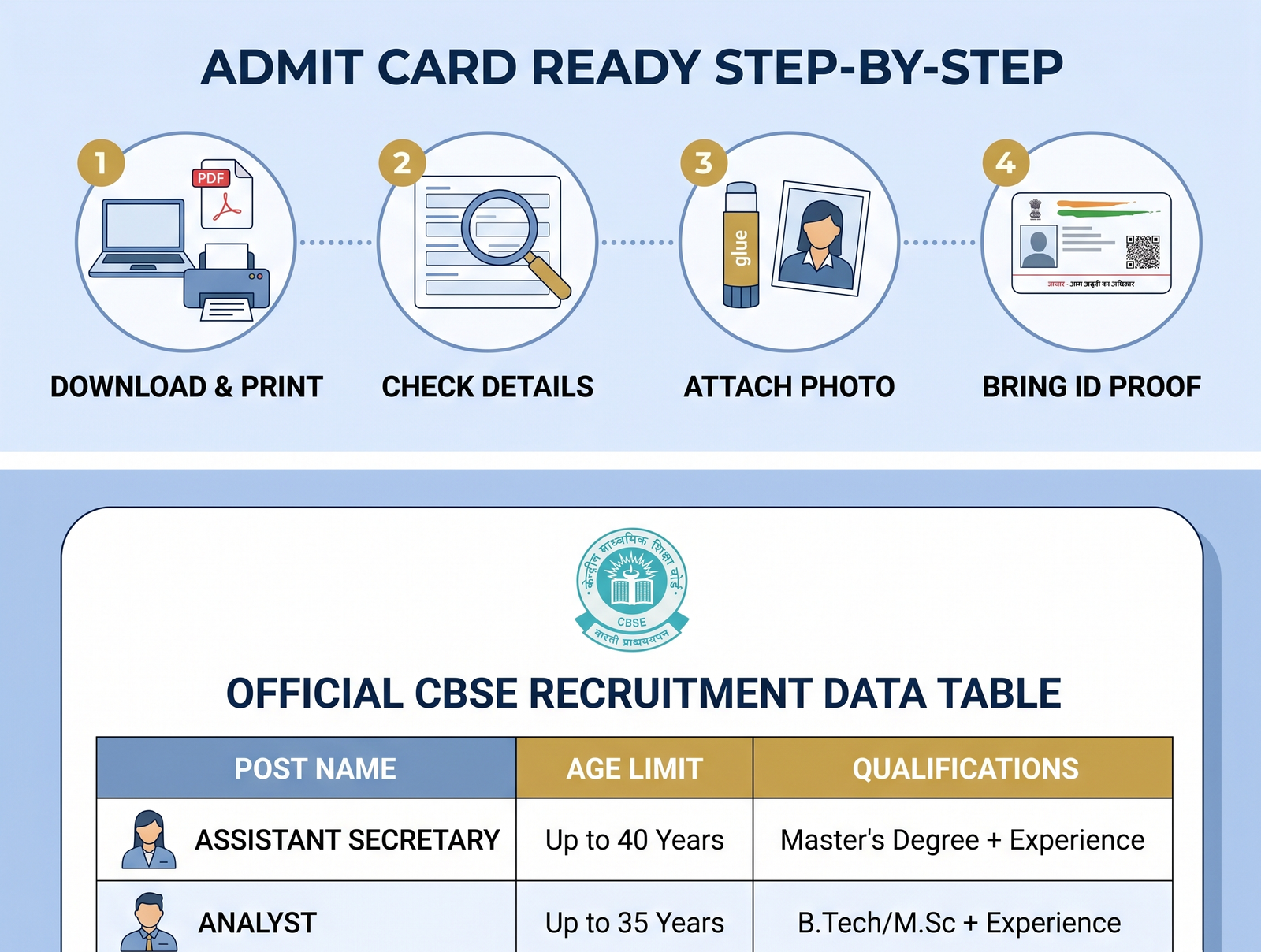
- Admit Card / Hall Ticket – contains your roll number, school number, and admit card ID
- Date of Birth proof – as registered with CBSE
- Aadhaar-linked mobile number – required for DigiLocker access
- School ID card – needed if you visit school to collect the physical marksheet
Remember: the online result is preliminary. Your actual signed marksheet and passing certificate will be issued by your school, or available as a digitally signed copy via DigiLocker. If you’re using your result for Class 11 admission before the physical marksheet arrives, the Phase 1 result on DigiLocker can be used provisionally.
8. What to Do If You Still Don’t Clear the Exam
If a student doesn’t pass even after Phase 2, they’re not without options:
- Compartment Exam: Expected in July 2026, with results expected in August 2026.
- Re-evaluation and Verification: Once the Phase 2 result is declared, you can apply online for answer sheet photocopies, marks verification, or re-evaluation in specific subjects, subject to CBSE’s fee and timeline for each service.
- Correction of Personal Details: If your name, date of birth, or other details are incorrect on the scorecard, report it to your school immediately, since this can affect college admissions later.
9. Common Mistakes Students Make
- Refreshing third-party websites obsessively instead of the official portal — this often shows outdated or incorrect data and adds unnecessary stress.
- Losing the admit card after the exam — you’ll need those exact details (roll number, school number, admit card ID) to access your result.
- Assuming Phase 2 marks always replace Phase 1 — remember, only the higher score is kept; a lower Phase 2 attempt doesn’t reduce your final marks, but it also doesn’t automatically replace a good Phase 1 score.
- Ignoring RL/RW status — leaving these unresolved can delay your final certificate and college admission process.
- Not downloading the DigiLocker copy — the website result is provisional; DigiLocker gives you a digitally signed version accepted for most official use.
10. Tips and Best Practices for Result Day
- Check the official site early in the morning; server load is usually lighter right after the link goes live.
- Cross-verify your marks against your own answer recollection or previous internal assessment marks — report discrepancies within the window CBSE provides.
- Save at least two copies of your result — one as a PDF download, one as a screenshot — before the site gets overloaded with traffic.
- If your family doesn’t have stable internet on result day, register the SMS method as a backup in advance.
- Talk to your school in the first 24–48 hours if you plan to request verification or re-evaluation, since document collection and fee submission windows are typically short.
Key Takeaways
- CBSE ran its first-ever two-exam system for Class 10 in 2026 under NEP 2020: Phase 1 (Feb–Mar, compulsory) and Phase 2 (May, optional improvement).
- The Phase 2 result is expected by June 30–early July 2026, though an official notification date wasn’t confirmed at the time of writing.
- CBSE uses a best-of-two scoring policy — your final marksheet keeps whichever score (Phase 1 or Phase 2) is higher in each subject.
- The passing requirement remains 33% per subject and overall.
- Results can be checked via the official website, DigiLocker, UMANG, and SMS.
- Students who still don’t pass can appear for the Compartment Exam in July, with results in August.
Conclusion
The CBSE Class 10 second exam system marks a genuine shift in how board results work in India — less pressure, more chances to improve, and a scoring method designed to only work in your favor. If you appeared for Phase 2, keep your admit card details handy, check the official portal directly, and use DigiLocker for your final signed marksheet. And if things don’t go your way this time, the compartment exam window in July gives you another fair shot. Stay calm, stay prepared, and check only official sources for your result.
FAQs
1. When will the CBSE 10th second exam result 2026 be declared? CBSE officials have indicated the result is targeted for around June 30, 2026, with some reports suggesting it could extend into the first week of July. No official notification with an exact date had been issued as of this writing.
2. What is the best-of-two policy in CBSE Class 10 2026? It means CBSE keeps the higher of your Phase 1 and Phase 2 marks for each subject you attempted in both exams, ensuring your final score can only improve, never drop.
3. Who was eligible to appear for the CBSE Class 10 Phase 2 exam? Students who passed Phase 1 and wanted to improve up to three subjects, students placed in compartment after Phase 1, and approved absentee candidates from Phase 1.
4. What do RL and RW mean on a CBSE marksheet? RL means “Result Later” and RW means “Result Withheld.” Both usually relate to pending verification and are resolved once your school confirms your details with CBSE.
5. How do I convert my CBSE CGPA to a percentage? Multiply your CGPA by 9.5. For example, a CGPA of 9.2 equals roughly 87.4%. This is the standard reference formula, not an official legal conversion.
6. What happens if I fail even after the second exam? You become eligible for the CBSE Compartment Exam, expected in July 2026, with results expected around August 2026.
7. Can I use my Phase 1 marksheet for Class 11 admission while waiting for the Phase 2 result? Yes, the Phase 1 result available on DigiLocker can generally be used provisionally for Class 11 admissions until the final documents are issued.