Introduction
If you’re an engineering graduate dreaming of a stable, respected government job in India’s telecom sector, this is the notification you’ve been waiting for. Bharat Sanchar Nigam Limited (BSNL) has officially opened direct recruitment for 100 Junior Telecom Officer (JTO) posts in 2026, and the buzz among ECE, EEE, IT, and Electronics graduates is real.
In this guide, you’ll learn everything about BSNL JTO Recruitment 2026 — the important dates, eligibility criteria, exam pattern, syllabus, salary structure, and a practical, week-by-week preparation strategy that actually works. Whether you’re a final-year student planning ahead or someone actively preparing for the CBT, this article covers what you need, in plain language, without the fluff.
Table of Contents
- What Is BSNL JTO Recruitment 2026?
- Important Dates
- Vacancy Details
- Eligibility Criteria
- Application Process (Step-by-Step)
- Application Fee
- Exam Pattern
- Syllabus Breakdown
- Salary & Service Bond
- Preparation Strategy & Tips
- Common Mistakes to Avoid
- Latest Updates & Trends
- Key Takeaways
- Conclusion
- FAQs
1. What Is BSNL JTO Recruitment 2026?
BSNL Junior Telecom Officer is an entry-level officer post in one of India’s oldest public sector telecom undertakings. This year’s drive falls under Advt. No. BSNLCO-11/12(11)/1/2026-RECTT-CO, and it’s a direct recruitment from the open market — meaning there’s no departmental quota advantage; every applicant competes on the same footing through a national-level Computer Based Test (CBT).
BSNL released the notification on 26th May 2026 for a total of 100 vacancies across different BSNL circles in India, with online applications for engineering graduates.
2. Important Dates — BSNL JTO 2026
| Event | Date |
|---|---|
| Notification release | 26 May 2026 |
| Online application start | 4 June 2026 |
| Last date to apply | 3 July 2026 (10:00 AM) |
| Application correction window | 4 July 2026 to 11 July 2026 (10:00 AM) |
| Tentative exam month | August 2026 |
Action tip: Complete your application at least 3–5 days before the closing date to avoid website traffic issues, payment failures, or form correction problems — a smart move given how BSNL’s portal tends to slow down near deadlines.
3. Vacancy Details
A total of 100 vacancies have been notified across different BSNL circles for the post of Junior Telecom Officer (Telecom). The posts are distributed circle-wise across India, so your final posting location will depend on the circle you select while applying and your merit rank.
4. Eligibility Criteria
Educational Qualification
Candidates must have a B.E./B.Tech or equivalent degree in Telecommunications, Electronics, Radio, Computer, Electrical, IT & Instrumentation, or an M.Sc. in Electronics or Computer Science. Candidates with M.Tech in the above disciplines are also eligible.
Important: The degree must be completed by the application closing date — final-year students whose results are awaited will not be eligible.
Age Limit
The age limit is 20 to 30 years. Age relaxation applies for reserved categories as per government norms — always verify the exact relaxation slab in the official PDF.
Other Eligibility Notes
- There’s a colour vision and binocular vision requirement — candidates with relevant visual impairments should carefully verify this condition before applying.
- Indian citizenship is mandatory.
- GATE score is not used in this cycle — selection is based entirely on the BSNL-conducted CBT, and GATE scores are not part of this recruitment process.
5. Application Process (Step-by-Step)
Here’s exactly how to apply:
- Visit the official BSNL recruitment portal.
- Click “Apply for BSNL JTO 2026” and choose New Registration.
- Fill in basic details to generate your application number and password.
- Log in with your credentials to access the full application form.
- Enter your personal and academic information along with exam centre preferences.
- Upload your passport-size photograph and scanned signature in the prescribed format.
- Pay the application fee via net banking, credit/debit card, or UPI.
- Download and save the confirmation page and application summary for future reference.
Pro tip: Keep scanned copies of your photo, signature, and degree certificate ready in the correct size/format before you start — this alone saves 80% of last-minute application stress.
6. Application Fee
The application fee is ₹2,000 for general category candidates and ₹1,000 for reserved categories (fee waivers may apply to certain categories as per the notification — check the official PDF for exact category-wise breakup).
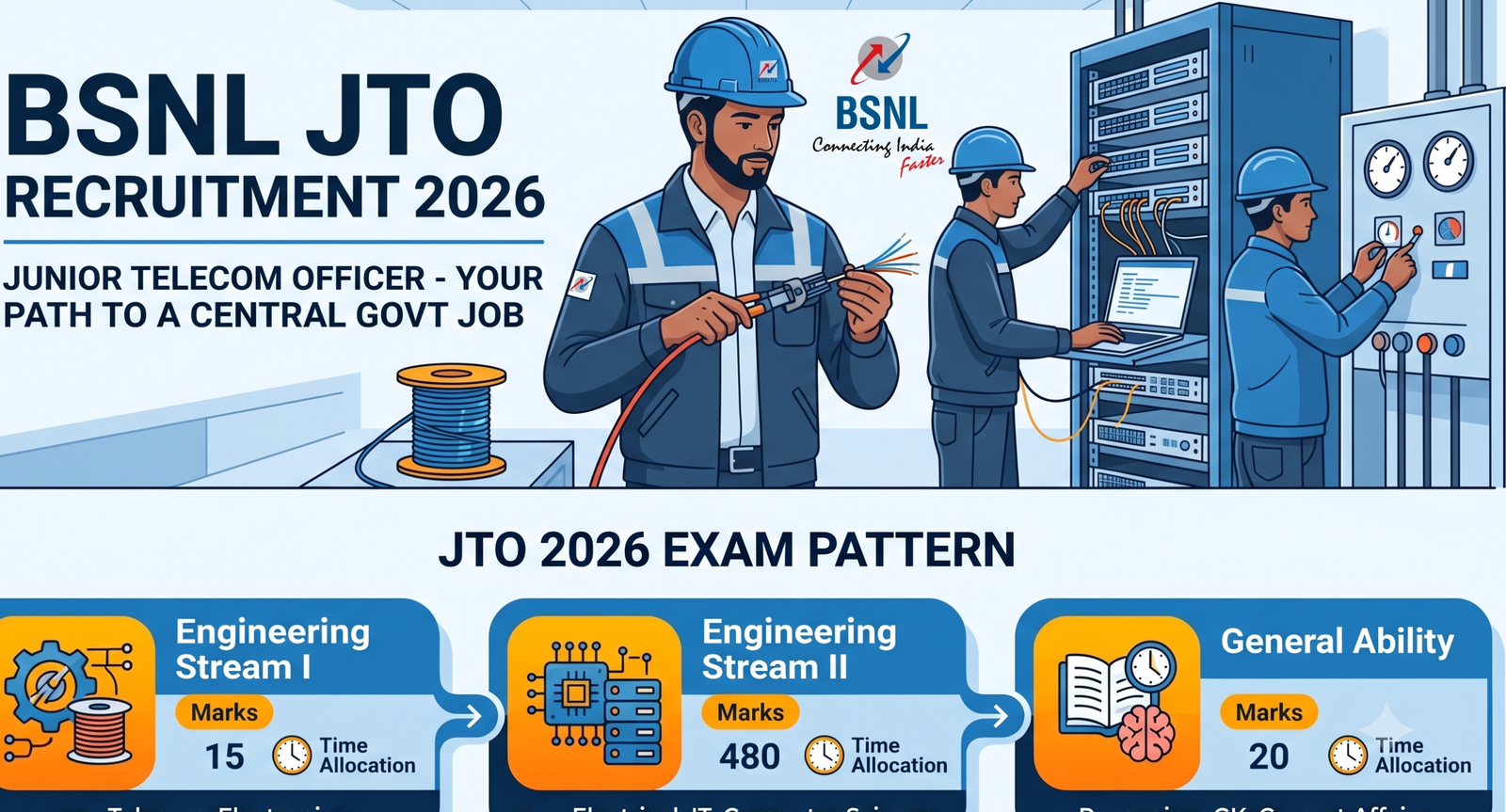
7. BSNL JTO Exam Pattern 2026
This is a single-stage objective exam, so understanding the pattern is half the preparation battle.
| Feature | Details |
|---|---|
| Mode | Computer Based Test (CBT) |
| Total questions | 120 questions |
| Total marks | 480 marks |
| Duration | 3 hours |
| Marking scheme | +4 for correct answer, -1 for wrong answer |
| Sections | Engineering Stream I, Engineering Stream II, General Ability Test |
| Sectional flexibility | Candidates can move freely between sections in any order during the exam |
Qualifying Marks
| Category | Sectional Minimum | Aggregate Minimum |
|---|---|---|
| General / OBC (CL) / EWS | 40% per section | 50% aggregate |
| SC / ST / OBC (NCL) / PwBD | 35% per section | 45% aggregate |
You must clear both the sectional and overall cut-off — scoring high overall but weak in one section won’t get you shortlisted.
Selection Stages
Merit in the CBT is followed directly by Document Verification (DV) and a Medical Examination — there is no interview stage. This makes the written exam your single biggest opportunity, so preparation quality matters enormously.
8. Syllabus Breakdown
Engineering Stream I & II (400 of 480 marks)
These two sections carry the heaviest weight and cover core electronics/telecom engineering topics such as:
- Electronic devices, circuits, and materials — electrical/thermal conductivity, semiconductors, magnetic materials, and passive components
- Communication systems and networks
- Digital electronics and microprocessors
- Basic computer science concepts
- Telecommunication principles and applications
The technical sections benchmark high-level engineering skills at a standard comparable to competitive exams like GATE or IES, so a thorough, foundational grasp of your official syllabus subjects is essential.
General Ability Test (80 marks)
This section measures basic communication, logical capacity, and situational awareness, and includes English comprehension and grammar, general knowledge, Indian history and geography, current affairs, reasoning, and recent developments in the telecommunications sector.
Insight: Many candidates ignore the General Ability section because it feels “easy,” but since it also has its own 40%/35% cutoff, skipping revision here can sink an otherwise strong technical score.
9. Salary, Bond & Career Path
- Pay scale: Entry-level IDA pay scale, starting around ₹16,400 (with regular increments and allowances as per BSNL’s IDA structure).
- Service bond: Selected candidates must sign a service bond of ₹6 lakh, committing to serve BSNL for a minimum of 5 years from the date of appointment.
- Probation: A 2-year probation period applies to all selected candidates.
- Training: Candidates must clear the BSNL training program; a second attempt is allowed if the training exam is failed the first time, but failing again can lead to cancellation of appointment.
Real-world perspective: As one industry analysis puts it, the entry pay scale doesn’t compete with private-sector packages for fresh ECE/EEE graduates, but job security, pension-like benefits under the PSU framework, and postings across 21 circles make this attractive to candidates who value stability and a structured promotion path over metro-city private salaries.
10. Preparation Strategy & Tips
Here’s a realistic, phase-wise plan assuming you have 6–8 weeks before the exam:
Weeks 1–3: Build the Foundation
- Cover core subjects from Engineering Stream I & II — networks, communication systems, digital electronics.
- Make short, one-page notes per topic for quick revision later.
Weeks 4–5: General Ability + Weak Areas
- Dedicate daily time to English, reasoning, and current affairs — especially telecom-sector news (5G rollout, BSNL 4G/5G Saathi network, spectrum policy updates).
- Revisit weak engineering topics identified from initial self-assessment.
Weeks 6–8: Mock Tests & Speed
- Practice previous-year papers and take timed mock tests — this is the most effective way to improve speed and accuracy.
- Simulate the full 3-hour CBT at least twice weekly to build stamina and section-switching comfort.
- Track your sectional scores against the qualifying cutoffs, not just your overall percentage.
Best Practices
- Since wrong answers cost you 1 mark, avoid blind guessing — attempt only when you can eliminate at least two wrong options.
- Revise formulas and circuit diagrams visually; engineering CBTs reward quick recall, not just understanding.
- Keep a rolling error log — note down every mistake in mocks and revisit it weekly.
11. Common Mistakes to Avoid
- Waiting for the last day to apply. Server crashes near deadlines are common in high-traffic PSU recruitments.
- Ignoring the General Ability section. It has its own cutoff — don’t treat it as a scoring afterthought.
- Applying without confirming degree completion. The degree must be completed by the application closing date.
- Skipping the notification PDF. Always download and thoroughly read the official BSNL notification PDF to check specific eligibility details, reservations, and document formats — third-party summaries (including this one) are helpful but the PDF is the final authority.
- Falling for fake portals. Verify you’re applying only on official government domains ending in .gov.in, .nic.in, or the official BSNL portal.
12. Latest Updates & Trends
- Unlike some earlier BSNL technical recruitment cycles that used GATE scores, this 2026 cycle relies entirely on BSNL’s own CBT, with GATE scores playing no role.
- With only 100 vacancies and nationwide competition, preparation depth matters considerably — expect a high cutoff given the volume of engineering graduates eligible.
- BSNL’s ongoing 4G/5G network expansion means questions on current telecom infrastructure trends could carry more weight in the General Ability section than in previous cycles.
Key Takeaways
- 100 JTO vacancies, applications open 4 June to 3 July 2026.
- Eligibility: B.E./B.Tech/M.Tech/M.Sc in relevant streams, age 20–30 years.
- Selection: CBT (120 Qs, 480 marks, 3 hours, +4/-1 marking) → Document Verification → Medical Exam. No interview.
- Sectional and aggregate cutoffs both must be cleared.
- 5-year service bond (₹6 lakh) and 2-year probation apply post-selection.
- Early application and consistent mock-test practice are your biggest edge.
Conclusion
BSNL JTO Recruitment 2026 is a genuine, no-nonsense opportunity for engineering graduates who want a stable PSU career in telecom rather than chasing another private-sector interview cycle. The process is transparent — one CBT, clear cutoffs, no interview politics — which means your preparation directly decides your outcome. Start early, respect the General Ability section as much as the technical papers, and treat mock tests as non-negotiable. If you fit the eligibility criteria, there’s little reason to sit this one out.
FAQs
1. What is the last date to apply for BSNL JTO Recruitment 2026?
The online application closes on 3 July 2026 at 10:00 AM.
2. How many vacancies are there in BSNL JTO 2026?
100 vacancies across various BSNL circles in India.
3. What is the age limit for BSNL JTO Recruitment 2026?
Candidates must be between 20 and 30 years old, with age relaxation for reserved categories as per BSNL norms.
4. Is GATE score required for BSNL JTO 2026?
No. Selection is based entirely on BSNL’s own Computer Based Test; GATE scores are not considered in this cycle.
5. What is the BSNL JTO exam pattern?
120 objective MCQs worth 480 marks across three sections (Engineering Stream I, Engineering Stream II, General Ability Test), 3-hour duration, +4 for correct and -1 for wrong answers.
6. Is there an interview in the BSNL JTO selection process?
No. Selection goes from CBT merit directly to Document Verification and Medical Examination — there’s no interview stage.
7. What is the service bond for BSNL JTO?
Selected candidates must sign a ₹6 lakh service bond to serve BSNL for a minimum of 5 years, with a 2-year probation period.